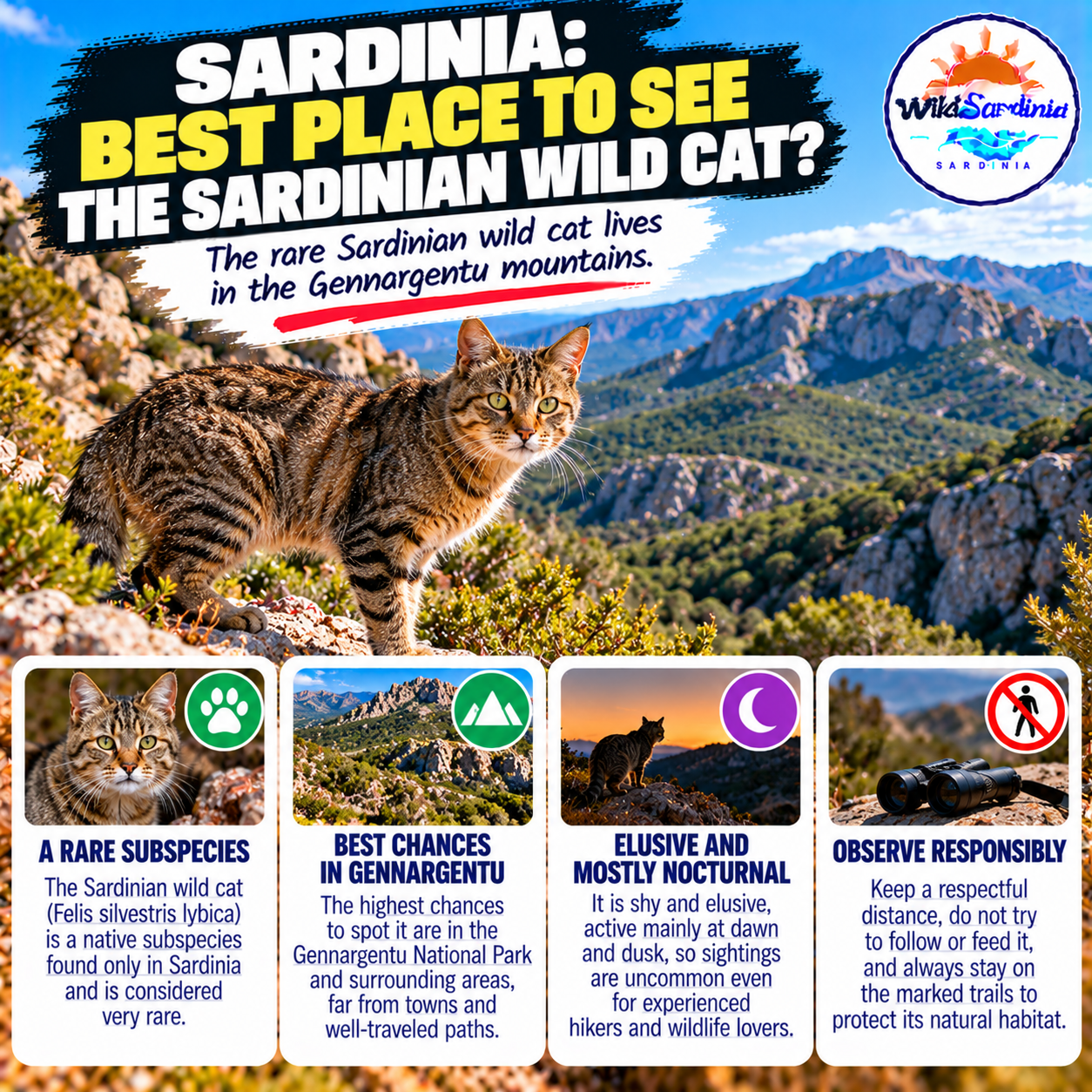
Sardinia is famous for its beaches, but its inland forests and rugged mountain landscapes shelter wildlife that most visitors will never see. One of the island’s most elusive residents is the Sardinian wildcat, a secretive feline that moves through Mediterranean scrub, woodland and rocky terrain. If you hope to spot one, the key is to understand where it has been recorded—and to accept that a sighting is far from guaranteed.
Where are Sardinian wildcats found?
Research and field reports indicate wildcat presence in several parts of Sardinia. The central and north-central mountains—including the Gennargentu massif, Barbagia and parts of Ogliastra—are among the areas associated with sightings. Reports and monitoring have also recorded wildcats in the south-west, including the Sulcis area. These are broad regions, not guaranteed viewing locations, and the animals’ exact distribution remains an active subject of research.
The Gennargentu is therefore a reasonable region to learn about Sardinia’s wild habitats, but it is not a wildlife park where visitors can expect to see a wildcat on demand. The animals are shy, occur at low densities and can disappear into dense vegetation with remarkable ease.
What is the Sardinian wildcat?
The wildcat living in Sardinia is commonly referred to as Felis silvestris lybica, part of the African wildcat lineage. Its origins on the island are linked to cats that reached the western Mediterranean long ago, although the exact history and timing of their arrival remain subjects of scientific discussion. This lineage is also associated with Corsica, so it is more accurate to describe it as the wildcat of Sardinia and Corsica rather than an animal found only in Sardinia.
It can resemble a tabby domestic cat at first glance, but wild individuals may show a sturdier appearance, a bushy ringed tail and other coat features. Appearance alone is not always enough to identify one reliably, especially from a distant or brief sighting.
Why is it so difficult to see?
The Sardinian wildcat is solitary, wary and mostly active around dusk, dawn and at night. It avoids people and uses woodland cover, Mediterranean scrub and rocky areas for shelter. Even in places where researchers have confirmed its presence, it may remain unseen for years by ordinary walkers.
Scientists often rely on camera traps, field signs and non-invasive genetic methods to study the animal. Recent research highlights how much remains to be learned about its distribution and genetics, as well as the threats posed by habitat fragmentation, road mortality and possible hybridisation with domestic cats.
Can you visit Monte Arcosu to see one?
Monte Arcosu, in the south-west of Sardinia, is another important area for wildlife observation. The WWF oasis has recorded Sardinian wildcats using camera traps, demonstrating that the species is present there. That does not mean visitors can expect to see one during a normal visit: camera-trap footage is often the result of long periods of monitoring, and the animals remain elusive.
If you visit a protected area, check its official access rules and follow the instructions of staff or guides. Never enter restricted areas or attempt to locate an animal by leaving established paths.
How to explore wildcat habitat responsibly
- Choose marked walking routes and respect protected-area rules and closures.
- Keep noise low and observe wildlife from a distance.
- Never feed, bait, chase or attempt to touch a wildcat.
- Do not set up your own traps or leave food to attract wildlife.
- If you photograph an animal, use a zoom lens and avoid revealing a precise location if sharing it could expose the animal to disturbance.
- Keep dogs under control and follow local guidance, especially in sensitive habitats.
What if you see a cat that looks wild?
Do not approach it to get a closer look. Take a photograph from a safe distance if you can do so without disturbing the animal, note the general area and report the observation to a local wildlife authority or a recognised monitoring project. Experts can assess the sighting; a quick glimpse is not always enough to distinguish a wildcat from a domestic or hybrid cat.
The best place is its natural habitat—not a guaranteed viewpoint
The Gennargentu, Barbagia and Ogliastra are among the Sardinian areas where wildcats have been reported, while monitoring in places such as Monte Arcosu has also documented their presence. But the best way to appreciate this rare and elusive animal is to explore Sardinia’s wild landscapes responsibly rather than expect a close encounter. A quiet walk through the island’s forests and mountains can be rewarding even if the wildcat remains hidden.
For further reading, see the scientific study “Unghosting the Sardinian wildcat: morphological and molecular characterization”, the WWF report on camera-trap footage from Monte Arcosu and the National Wildcat Project hosted by the Museum of Natural History of Maremma.