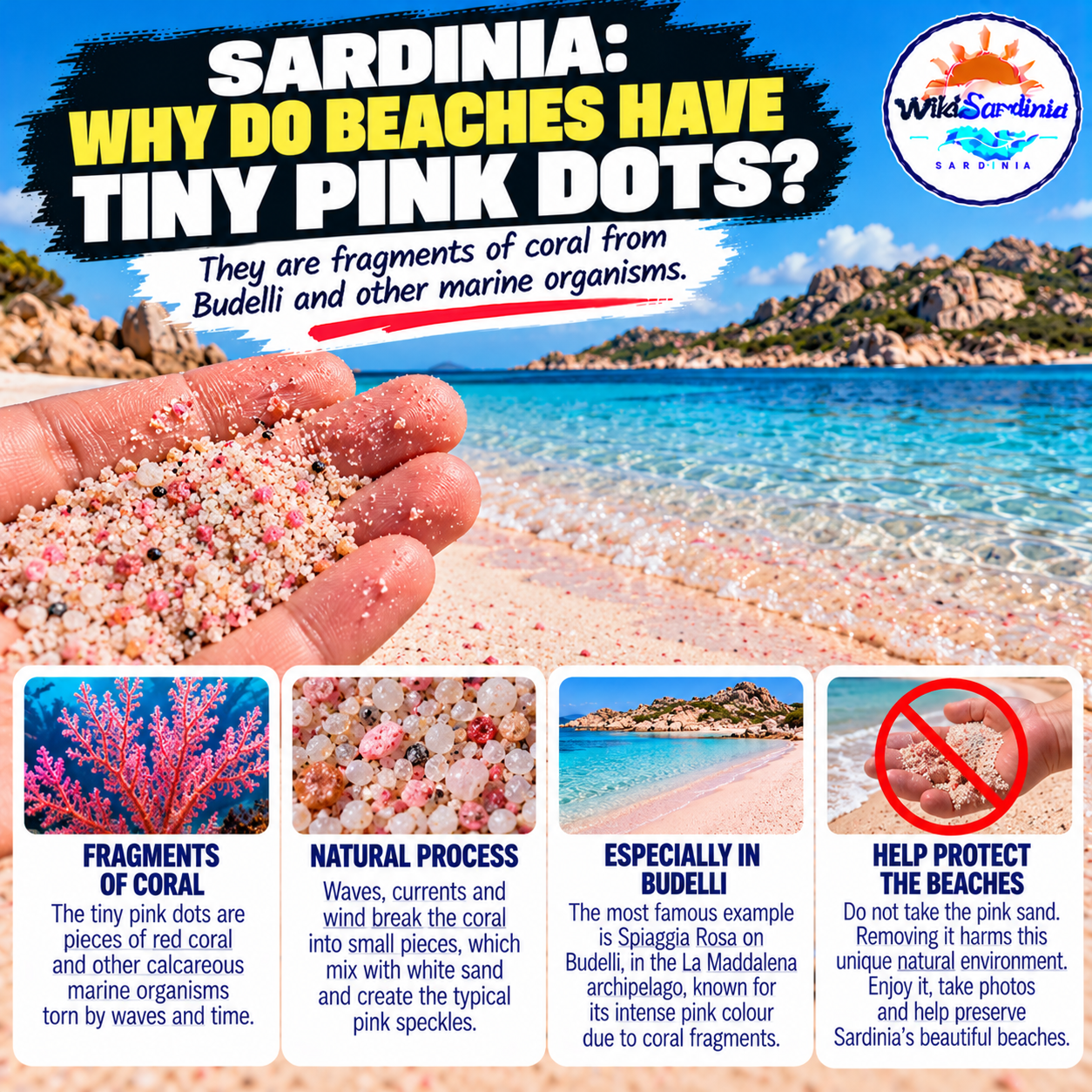
Have you ever noticed tiny pink dots mixed into the pale sand on a Sardinian beach? The colour can look like someone sprinkled the shoreline with little flecks of rose. One of the best-known examples is Spiaggia Rosa on Budelli, in the La Maddalena Archipelago—but the science behind the colour is more interesting than the idea that the sand is simply made of crushed coral.
What are the tiny pink dots?
At Budelli’s famous Pink Beach, much of the distinctive colour comes from the calcareous shells of a microscopic marine organism called Miniacina miniacea, a red foraminifer. It lives among the underwater meadows of Posidonia oceanica, a seagrass native to the Mediterranean. When the organism dies, its tiny shells can become part of the coastal sediment.
The sand also contains a mix of other natural materials, including fragments of shells, granite and the skeletons of marine organisms such as bryozoans. So, although people often describe the pink flecks as coral, the characteristic colour at Spiaggia Rosa is particularly associated with these tiny foraminifer shells and other biogenic fragments.
How do the pink flecks reach the shore?
Waves, currents and wind gradually move and break down tiny shells and other fragments. They mix with the beach’s pale mineral grains, creating the pinkish tint. The colour is not evenly distributed: it depends on the local sediment, marine habitats, water movement and the amount of pink material present.
This is a natural process that takes place over time. It is not dye, pollution or a sign that someone has coloured the sand.
Why is Budelli’s Spiaggia Rosa so famous?
Spiaggia Rosa lies on the south-eastern side of Budelli, within the La Maddalena Archipelago National Park. Its unusually delicate pink shoreline became widely known through its striking landscape and its appearance in Michelangelo Antonioni’s 1964 film Red Desert. The beach is also an important reminder that a beautiful coastal landscape can be extremely fragile.
Can you walk on the Pink Beach or collect a little sand?
No. Spiaggia Rosa is under strict protection in Zone A of the national park. Access to the beach itself is prohibited, as are swimming and anchoring or stopping boats in the protected strip of sea in front of it. Visitors can admire it from authorised viewpoints and routes, following the park’s instructions.
Do not take sand, shells or fragments as souvenirs. Removing sediment changes the very material that gives the beach its distinctive appearance, and repeated disturbance can harm the coastal habitat. A photograph is the best souvenir—and it leaves the beach where it belongs.
How to see Spiaggia Rosa responsibly
- Plan to view the beach from authorised viewpoints or with a permitted local excursion.
- Follow the national park’s signs and instructions, and do not enter the protected sand.
- Never collect sand, shells or other natural fragments.
- Respect boat restrictions and remain outside the protected marine area.
- Keep the landscape clean and avoid disturbing the surrounding seagrass and wildlife.
Are all pink specks on Sardinian beaches the same?
Not necessarily. Beach sediment varies around the island, and small pink grains can have different origins depending on the location. Budelli’s Spiaggia Rosa is a particularly famous case because of the abundance of pink calcareous shells and other marine fragments. It is best not to assume that every pink grain on every beach is coral or comes from the same organism.
The takeaway
The tiny pink dots are a natural clue to life beneath the sea. At Budelli’s Spiaggia Rosa, the famous colour is closely linked to the microscopic foraminifer Miniacina miniacea, whose shells mix with other marine and mineral fragments. Because this landscape is so delicate, the right way to enjoy it is from authorised viewpoints—without stepping onto the beach or taking anything away.
For further details, consult the La Maddalena National Park information on Budelli, the Comune di La Maddalena’s Spiaggia Rosa guide and the official SardegnaTurismo page.