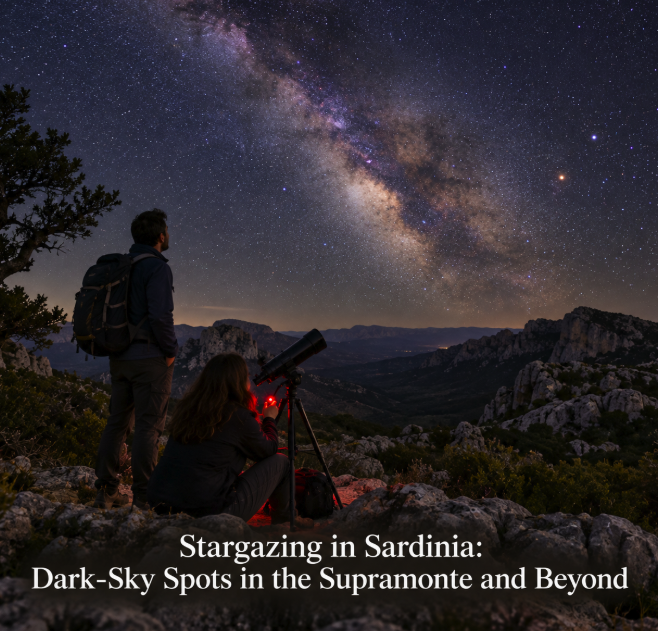
Sardinia has an advantage that becomes obvious only after sunset: away from its larger towns and busy coastal resorts, extensive mountain and rural landscapes have relatively few artificial lights. The Supramonte is particularly tempting for stargazers because its limestone plateaus, forests and deep valleys cover more than 35,000 hectares across Baunei, Dorgali, Oliena, Orgosolo and Urzulei. But the darkest-looking place on a map is not automatically the safest place to visit at night, and travelers looking for an astro-tour should balance darkness with road access, terrain and local knowledge.
Sardinia’s official tourism portal actively promotes the island for night-sky observation, describing its combination of limited artificial light and clean air and highlighting plateaus, cliffs and headlands as natural stargazing locations. It also points visitors toward organized astronomical facilities in Ogliastra when a guided telescope experience is preferable to exploring remote countryside alone.
The Supramonte: extraordinary darkness, difficult terrain
The Supramonte is not a literal desert. It is a vast, rugged mountain system of plateaus, sinkholes, forests, caves, cliffs and canyons in central-eastern Sardinia. Its sparse settlement and wild character are exactly what make parts of it attractive after dark, but they also make casual nighttime exploration a poor idea.
One of the most accessible approaches to the landscape is around the Golgo plateau above Baunei. Official Sardinian tourism material describes Golgo as a gateway into the Supramonte di Baunei, a striking highland landscape containing the deep karstic chasm of Su Sterru and archaeological remains. Rather than hiking deep into unknown terrain at night, astro-photographers should choose a legal, established stopping place reached on a known road and scout it during daylight first.
Another useful orientation point is the Genna Silana area on the SS125 above Gorropu. From the pass, the landscape opens toward the Supramonte areas of Urzulei, Orgosolo, Oliena and Dorgali and toward the Gennargentu. The setting is dramatic, but anyone staying after dark should account for mountain weather, traffic, roadside safety and the absence of ordinary tourist services.
Remote Supramonte trails should not be treated as nighttime observatory paths. Deep canyons, limestone holes, uneven tracks and limited mobile coverage can turn a simple stargazing outing into a navigation problem. A local hiking or astronomy guide is a much better choice if the plan involves leaving established roads or staying deep in the mountains after dark.
Monte Armidda: a real astronomy destination in Ogliastra
Travelers who want telescopes and expert guidance have a stronger option near Lanusei. The Ferdinando Caliumi Astronomical Observatory on Monte Armidda, around ten kilometres from the town, has welcomed the public for decades. The local astronomical association describes the site as having clear air and an almost total absence of light pollution and organizes public observing evenings as well as occasional sessions elsewhere.
This makes Monte Armidda particularly useful for visitors who want more than a dark roadside viewpoint. Instead of trying to identify planets and deep-sky objects alone, participants can observe through astronomical equipment and learn from people who know the local sky. Visits and public evenings should be arranged through the observatory rather than assumed to be available every night.
Other dark-sky possibilities around Sardinia
Southern Sardinia also has areas where astronomical observation benefits from darker rural skies. The tourism office in Castiadas describes its astronomical observatory area at Maloccu as one of the places in Italy where dark, clear skies remain suitable for high-level astronomical imaging. Its public programming is still something travelers should verify in advance rather than expecting a nightly visitor attraction.
For a different astronomy experience, the Sardinia Radio Telescope at San Basilio is one of the island’s major scientific landmarks. Operated by INAF’s Astronomical Observatory of Cagliari, the enormous radio telescope periodically opens for free guided visits. The 2026 public calendar includes dates from March through December, but visitors do not use the radio telescope for visual stargazing; the visit explains the facility and allows participants to see the instrument from close range when conditions permit.
SardegnaTurismo also highlights the island’s solitary headlands, plateaus and archaeological landscapes as places where stars can dominate the view. That means travelers do not necessarily need to drive into the deepest mountains. A safe rural location well away from streetlights can be more useful than a theoretically darker spot that requires difficult navigation.
How to choose a good stargazing night
Light pollution is only one part of the equation. Moonlight can wash out the Milky Way even in a very dark location, while cloud, haze and humidity can reduce visibility. For a Milky Way-focused trip, check the lunar phase and the time the Moon rises and sets, then compare that with astronomical twilight for your exact date.
A new moon is helpful but not compulsory. If the Moon sets early, several dark hours may remain. Conversely, a bright full Moon can be excellent for photographing Sardinian landscapes at night even if faint stars become harder to see.
Summer provides warm nights and a prominent Milky Way, but Sardinia can offer rewarding astronomy in every season. Official tourism material notes meteor showers throughout the year and particularly famous shooting-star nights in August. Autumn can be attractive because nights become longer and busy coastal areas quiet down, although mountain weather becomes less predictable.
Astrophotography without disturbing the darkness
A phone with a modern night mode can capture surprisingly good star fields when placed on a stable support. With a camera, a wide-angle lens, tripod and manual exposure provide more control. Use the dimmest practical light while setting up and switch off bright screens once your eyes adapt.
A red torch is useful because it interferes less with night vision than a bright white beam. It is also considerate when other observers are nearby. Avoid shining lights toward photographers during long exposures and never illuminate wildlife, archaeological remains or private buildings merely to create an image.
For foregrounds, Sardinia offers limestone ridges, shepherd landscapes, trees and distant mountain silhouettes. Archaeological sites can also create striking compositions, but access rules still apply after closing time. A beautiful nuraghe visible from a road is not an invitation to enter a fenced or closed site at night.
Safety matters more than finding the darkest pixel on a map
Anyone heading into rural Sardinia after dark should download offline maps, carry water and warm layers, keep a charged phone and tell someone where they are going. Mountain temperatures can be substantially cooler than the coast, even after a hot day.
Do not park where a vehicle obstructs a road or agricultural access, and respect gates and private land. In the Supramonte, avoid entering caves, canyons or unfamiliar trails at night. If an astro-tour promises access to remote terrain, check who is guiding it, what transport is included and how the return journey is handled.
The best dark-sky experience in Sardinia is not necessarily the most isolated one. For independent travelers, an accessible rural viewpoint scouted in daylight may provide a superb Milky Way with much less risk. For those who want true astronomical interpretation, Monte Armidda offers the added value of telescopes and experienced observers.
The Supramonte remains the romantic choice: a vast, sparsely settled landscape where darkness feels unusually complete. Treat it as wilderness rather than an attraction, however, and Sardinia’s night sky can become one of the most memorable parts of an autumn or summer trip.