American travelers arriving in Sardinia do not need to bring U.S.-style tipping habits with them. Tipping in Italy is not compulsory, and a restaurant server is not normally waiting for a 20% gratuity to be added to every bill. A tip is instead a voluntary way to recognize service you genuinely appreciated. Cards and contactless payments are increasingly common, but carrying some euros remains useful, particularly for small purchases and situations where cash is simply more convenient.
Italy’s official tourism portal is clear on the basic point: tips are not mandatory and there is no fixed national tipping rule. It suggests that around 10% can be left when a customer is particularly satisfied. For U.S. visitors, however, the most important cultural adjustment is not the exact percentage. It is understanding that a large automatic tip is not an expected part of every transaction.
Restaurants: check the bill before adding a tip
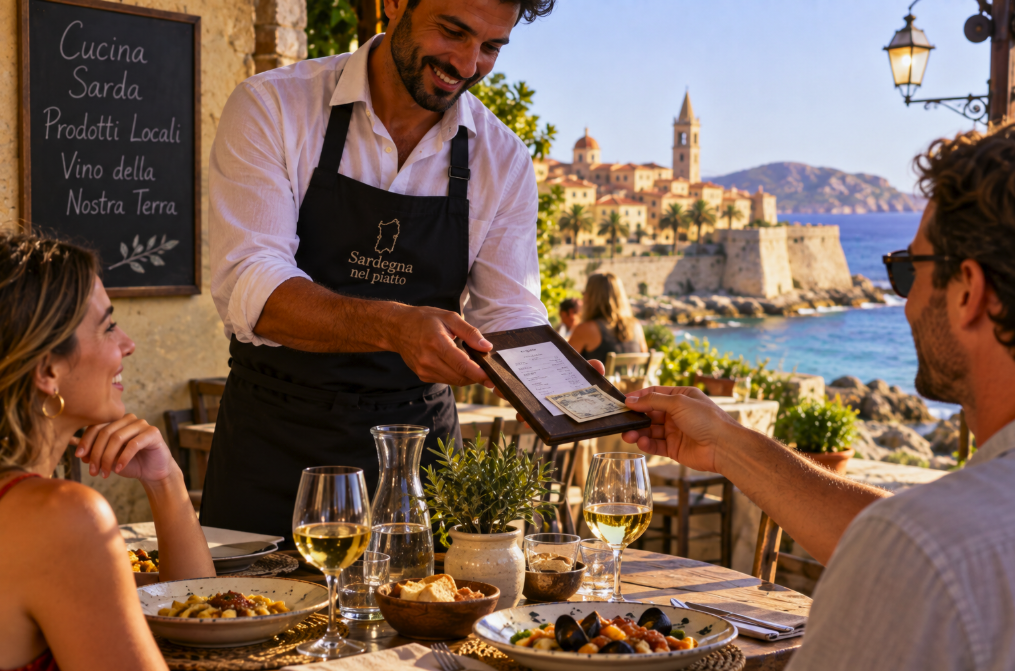
At a Sardinian restaurant, read the menu and final bill before deciding what to leave. You may see a coperto, a per-person cover charge associated with table service and items such as bread or place settings. It is not the same thing as a voluntary tip to your waiter.
You may also encounter a clearly stated service charge in some establishments, especially in tourism-oriented settings or for particular groups and events. If service is already included, there is no reason to treat another large percentage as obligatory. When no service charge is present and the service was excellent, rounding up or leaving a modest extra amount is perfectly acceptable.
For example, on a €76 dinner, paying €80 is a natural gesture if you were happy. On a special meal with unusually attentive service, you may choose to leave more. There is no need to calculate 18%, 20% or 25% simply because those percentages would be familiar in the United States.
Bars and cafés
For an espresso taken standing at the counter, tipping is generally unnecessary. If you want to leave small change after friendly service, you can, but nobody should treat it as a required percentage.
Table service can work differently from counter service, particularly in busy resort areas and prominent piazzas. Prices themselves may be higher when you sit at a table, depending on the establishment. Check the menu rather than assuming that the difference is a tip.
The same principle applies to an aperitivo or drinks at a beach bar: pay the listed price and add a small gratuity only if you want to recognize particularly good service.
Hotels, taxis and private drivers
There is no universal Sardinian rule requiring tips for every hotel interaction. At an upscale hotel, guests may choose to give a few euros to someone who handles significant luggage or provides especially helpful personal service. Housekeeping tips are also optional rather than compulsory.
With taxis, rounding up a fare is an easy way to show appreciation, but an American-style percentage is not automatically expected. Private drivers and guides are more variable because the service may last several hours or a full day. If a guide or driver has provided exceptional personal service, a voluntary tip is appropriate, but travelers should first check whether gratuities or service charges are already addressed in the booking conditions.
Can you pay by card in Sardinia?
Yes, in most normal travel situations cards are widely useful. Italy’s official tourism information lists major international payment networks, including Visa, Mastercard and American Express, while Banca d’Italia documents the continuing growth of card and digital payments. Contactless card and mobile payments are also well established.
Recent Banca d’Italia research shows how quickly habits are changing: cash still represented 61% of point-of-sale transactions by number in the 2024 consumer survey, down from 69% in 2022 and 82% in 2019, while cards rose to 32%. In August 2026, the central bank again highlighted strong growth in digital payment instruments while noting that cash continues to play an important role.
That national picture is useful for Sardinia. A traveler can reasonably expect to use cards at hotels, supermarkets, many restaurants, shops, fuel stations and other established businesses. But it is still sensible to carry cash rather than travel with a card as the only possible payment method.
Why carry euros if cards are common?
Small amounts of cash remain practical for markets, minor purchases, small bars, parking situations, tips and occasions when a terminal or connection is temporarily unavailable. Some rural or seasonal businesses can also be less convenient for electronic payments than a large hotel or supermarket in Cagliari, Olbia or Sassari.
You do not need to travel around with a thick envelope of banknotes. A modest cash reserve in smaller denominations is usually more useful. ATMs are available in towns and tourist areas, although travelers should check their own bank’s withdrawal and foreign-exchange fees before departure.
If a payment terminal offers to charge a U.S. card in dollars rather than euros, read the exchange-rate information carefully. Your card issuer’s terms and the merchant’s currency-conversion offer determine which option is better, so do not accept a conversion automatically without looking at the rate and fees.
What about leaving a tip on a card?
Do not assume the checkout process will work like a U.S. restaurant terminal with a familiar tip screen. If you want to leave a gratuity, the simplest approach can be to pay the main bill by card and leave a few euros in cash. You can also ask the restaurant whether a tip can be added electronically before the transaction is completed.
This is one reason small euro notes and coins are useful even for travelers who otherwise pay almost everything by card.
A simple rule for American visitors
The easiest way to adapt is to separate payment from gratuity. The bill is the amount you owe; a tip is an optional extra for service you appreciated. Read the menu for cover or service charges, pay the stated bill, and then decide whether you want to round up or leave something more.
That approach works from a casual trattoria in Alghero to a resort restaurant on Costa Smeralda. It also avoids two common mistakes: leaving a large U.S.-style tip because you think it is compulsory, or refusing to leave anything because you have heard that “Italians never tip.” Neither extreme accurately captures the culture.
For a Sardinia trip, bring at least one widely accepted card, a backup payment method and a modest amount of euros. Use cards where convenient, keep some cash for small transactions and tips, and treat gratuities as appreciation rather than an obligation. For most U.S. travelers, that is the only adjustment needed.