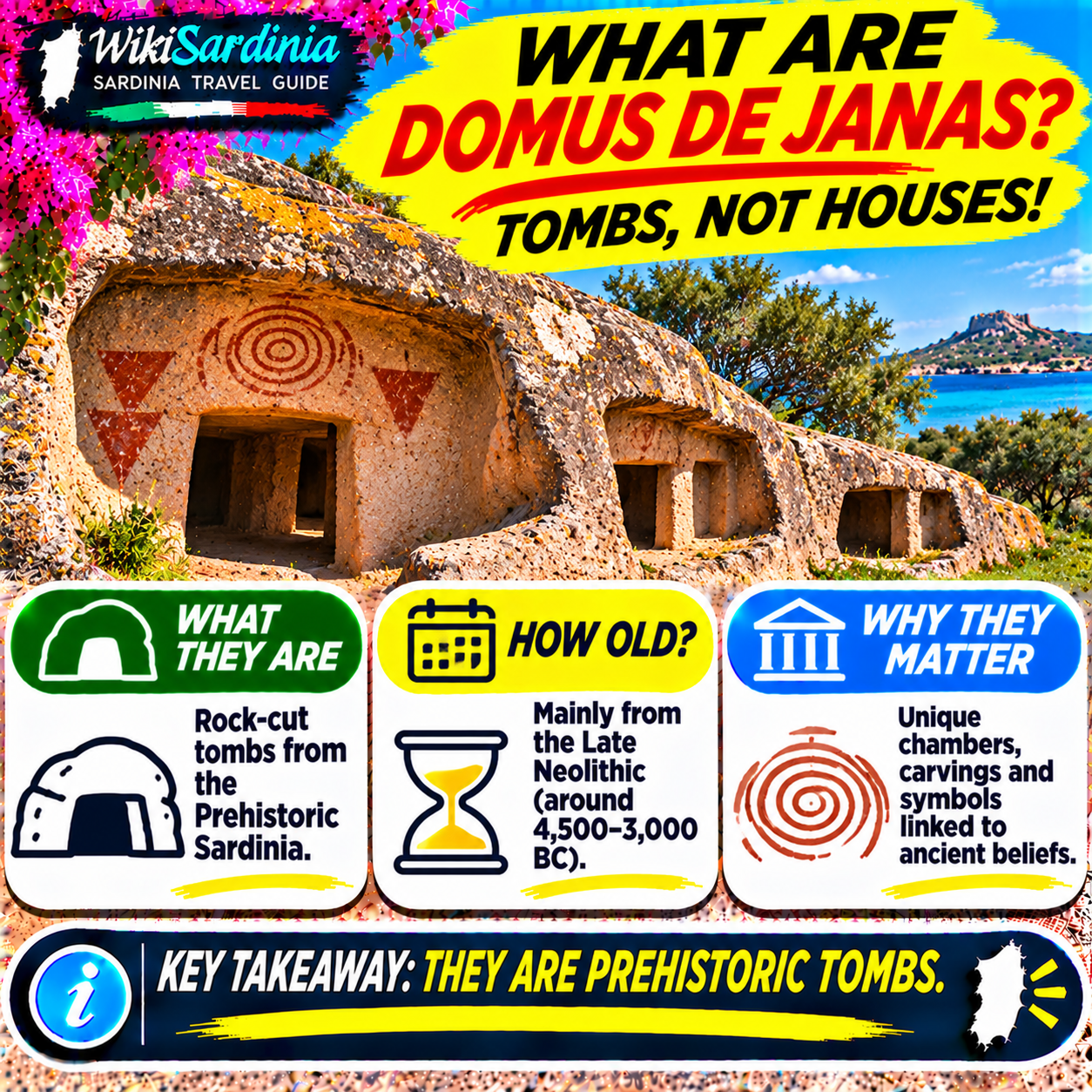
Domus de Janas are prehistoric rock-cut tombs, not houses where people lived. Found across Sardinia, these remarkable underground burial chambers were carved into natural rock beginning in the Late Neolithic, thousands of years before the island's famous nuraghi. Their name means “Houses of the Fairies” in Sardinian folklore. The nickname is poetic, but the archaeology is clear: these were places for the dead, sometimes deliberately shaped to resemble the homes of the living.
What does Domus de Janas mean?
Domus de Janas is commonly translated as “Houses of the Fairies” or “Fairy Houses.” In Sardinian storytelling, janas are supernatural beings associated with hidden places, beauty, weaving and treasure. Folklore offered an explanation for the small entrances and mysterious chambers long before modern archaeology established their original purpose. The stories are an important part of Sardinian cultural heritage, but they should not be confused with archaeological evidence about who built the tombs.
Were they tombs or prehistoric homes?
They were tombs. Archaeological investigations identify the chambers as funerary spaces, frequently used for collective burials and sometimes reopened or reused over long periods. Some contain stone-carved features that imitate domestic architecture: doorframes, roof beams, pillars, false doors and other details associated with the houses of the living. This has led scholars to describe them as symbolic homes for the dead. A room resembling a house is not evidence that an ancient family lived there as an ordinary dwelling.
How old are the Domus de Janas?
The tradition began during Sardinia's Late Neolithic, broadly in the fifth to fourth millennia BCE, and continued into the Copper Age, with some sites used or modified in later prehistoric periods. Many well-known examples are associated with the Ozieri cultural horizon, roughly the fourth millennium BCE. Dates differ between necropolises and between their construction and later reuse. In everyday terms, some are more than 5,000 years old—considerably older than the classic Bronze Age nuraghi, whose major construction phase began around the second millennium BCE.
How were the tombs made?
Builders excavated chambers directly into relatively workable rock using the tools and techniques available to prehistoric communities. A tomb might begin with a small entrance or passage leading to a central room and multiple side chambers. Some were cut into hillsides; others are accessed through openings in flat rock. Their layout varies enormously: one site may have simple cavities, while another contains elaborate multi-room funerary complexes with carefully shaped ceilings and doorways. The small openings often require visitors to crouch, which is another reason not to mistake them for normal domestic houses.
Why do some look like miniature houses?
Carved pillars, beams, hearth-like details and false doors appear to reflect ideas about domestic space and the afterlife. The dead may have been symbolically provided with a lasting dwelling, but precise religious beliefs cannot be reconstructed with certainty. Archaeologists interpret these features using architecture, grave deposits, painted decoration and comparisons across sites. It is more accurate to say that the tombs evoke houses than to claim we know exactly what every prehistoric family believed.
What do the carved spirals, horns and red paint mean?
Some Domus de Janas contain red-ochre paintings, geometric motifs, spirals, false doors and horn-shaped reliefs. These are important evidence of prehistoric symbolic expression. Interpretations connect certain motifs to ritual, death, regeneration and possibly sacred animals, but there is no complete written explanation from the people who created them. Red pigment is sometimes associated with life or renewal in archaeological interpretation, yet assigning a single fixed meaning to every painted surface would go beyond the evidence. Visitors should never touch or wet the carvings to make them show up in photographs.
Are Domus de Janas a UNESCO World Heritage Site?
Yes. In July 2025, UNESCO inscribed the serial property “Prehistoric Funerary Traditions of Sardinia – The domus de janas” on the World Heritage List. The inscription encompasses 17 component sites representing the island's outstanding rock-cut funerary tradition. That does not mean every Domus de Janas on Sardinia is individually part of the UNESCO listing: thousands of chambers exist across many different locations, with different levels of protection, interpretation and visitor access. For the definitive list of inscribed components, consult the UNESCO World Heritage Centre.
How many are there in Sardinia?
Researchers have recorded thousands of Domus de Janas across the island; published inventories commonly cite more than 3,000, although totals vary as sites are discovered, surveyed or reclassified. Many are small, weathered or located on private or difficult terrain. A mapped tomb is not necessarily a staffed tourist attraction, and an entrance visible from a road does not mean it is legal or safe to enter.
Which Domus de Janas should first-time visitors see?
Anghelu Ruju — near Alghero
Necropolis of Anghelu Ruju is a particularly useful introduction for travelers staying in Alghero or northwestern Sardinia. The archaeological site contains a large group of rock-cut tombs, with corridors, chambers and features that illustrate how elaborate these prehistoric burial places could be. It is a practical cultural stop to combine with the Alghero area, but check current opening times, admission, guided-tour options and access limitations before visiting. Do not assume every chamber is open or suitable for visitors with mobility difficulties.
Sant'Andrea Priu — near Bonorva
Necropolis of Sant'Andrea Priu, in the Bonorva area, is famous for its large and complex rock-cut chambers, including the so-called Tomb of the Chief. It also shows how ancient places could be reused in later historical periods. The site's interiors can be uneven or enclosed, so visitors with claustrophobia or limited mobility should ask about the route before buying tickets.
Montessu — near Villaperuccio
Necropolis of Montessu in southwestern Sardinia combines a striking hillside landscape with a substantial prehistoric burial complex. It can be a rewarding option for visitors exploring the Sulcis region. Its outdoor setting also means exposure to sun, uneven ground and walking distances; verify the practical access conditions with the site manager.
Other important sites
Sites such as Sos Furrighesos near Anela and Mesu 'e Montes near Ossi are important for understanding the variety of prehistoric rock-cut architecture and decoration. However, their archaeological significance does not guarantee straightforward tourist access. Check whether visits are permitted, whether a guide is required and whether any route crosses private property.
Which site is best if I am not an archaeologist?
For someone based in Alghero, Anghelu Ruju is an excellent first choice because it offers an identifiable archaeological destination and a clear connection to the region's prehistoric past. For visitors already traveling through the Logudoro, Sant'Andrea Priu offers particularly impressive interiors. In the Sulcis, Montessu makes a memorable landscape-and-archaeology excursion. The best choice depends on where you are staying and how much walking or confined-space exploration you enjoy; there is no single universally best site.
How are Domus de Janas different from nuraghi?
Domus de Janas are rock-cut funerary chambers, mainly originating in the Neolithic and Copper Age. Nuraghi are freestanding stone towers and complexes, built predominantly during the Bronze Age. They belong to different archaeological traditions and served different purposes. A visit to both offers a much richer picture of Sardinia's prehistory than either monument type alone.
Can you go inside the tombs?
That depends on the individual site, its conservation condition and the operator's rules. Some visitor sites allow access to selected chambers, often under supervision. Others restrict interiors to protect fragile surfaces or because passages are unsafe. Never crawl through a blocked opening, remove stones, touch paintings or enter a chamber simply because its entrance is visible. For visitors with claustrophobia, the small doors and enclosed rooms may be uncomfortable; ask about an exterior-only visit before traveling.
Are they suitable for children and wheelchair users?
Children may find the rock-cut rooms fascinating, but low entrances, slippery stone, unprotected edges and uneven paths require close supervision. Wheelchair access varies widely and may be impossible inside original chambers even if a car park or ticket office is accessible. Ask the operator about step-free approaches, the specific route, toilets and whether the experience can be enjoyed from outside. Sturdy shoes, drinking water and sun protection are sensible, especially in summer.
Can I visit them for free?
Some tombs are visible in the countryside without a staffed entrance, while managed archaeological sites may charge admission or require a guided visit. Do not assume that an unstaffed location is public property or freely accessible. Fees, seasonal schedules and booking rules change, so check the relevant municipality, museum or archaeological operator rather than relying on an old blog or map listing. This article does not claim live ticket availability.
Can I photograph or fly a drone over them?
Ordinary personal photography may be permitted at some managed sites, but flash, tripods, commercial photography or drone operations can be restricted. Drone flying is subject to Italian aviation rules and any archaeological, environmental or local limitations. A UNESCO designation is not permission to fly. Ask the site operator and consult the applicable official flight restrictions before planning aerial footage. Never use chalk, water or physical contact to enhance carvings for a photograph.
What should I look for during a visit?
Look for the relationship between entrance, central chamber and side rooms; the way ceilings or columns imitate houses; any preserved carved motifs or traces of pigment; and how the tomb is positioned in the landscape. Imagine the skill required to excavate rooms from solid rock without modern machinery. Interpretation panels or a guide can help distinguish prehistoric features from later alterations and modern damage.
Useful Italian phrases
“Queste sono tombe o abitazioni?” — Are these tombs or homes? “Si può entrare nelle camere funerarie?” — Can we enter the burial chambers? “È necessaria una visita guidata?” — Is a guided visit required? “Ci sono decorazioni originali?” — Are there original decorations? “Il percorso è accessibile?” — Is the route accessible? “Qual è l'ultimo ingresso?” — What time is the last admission?
Sources and further reading
UNESCO World Heritage Centre — Prehistoric Funerary Traditions of Sardinia: The domus de janas; SardegnaTurismo — Anghelu Ruju; SardegnaTurismo — Sant'Andrea Priu; SardegnaTurismo — Montessu; Italia.it — Domus de Janas overview. For current admission, conservation closures and accessibility, consult each site's official operator before traveling.
The WikiSardinia takeaway
Domus de Janas are ancient tombs that were sometimes carved to look like houses—not prehistoric homes for living families. Their chambers preserve evidence of Sardinian communities more than five millennia ago, long before the famous nuraghi. The fairy-house name comes from folklore, while archaeology reveals collective burial practices and remarkable symbolic art. If you are staying near Alghero, start with Anghelu Ruju; elsewhere, consider Sant'Andrea Priu or Montessu. Their 2025 UNESCO recognition makes these sites an essential part of Sardinia's story.