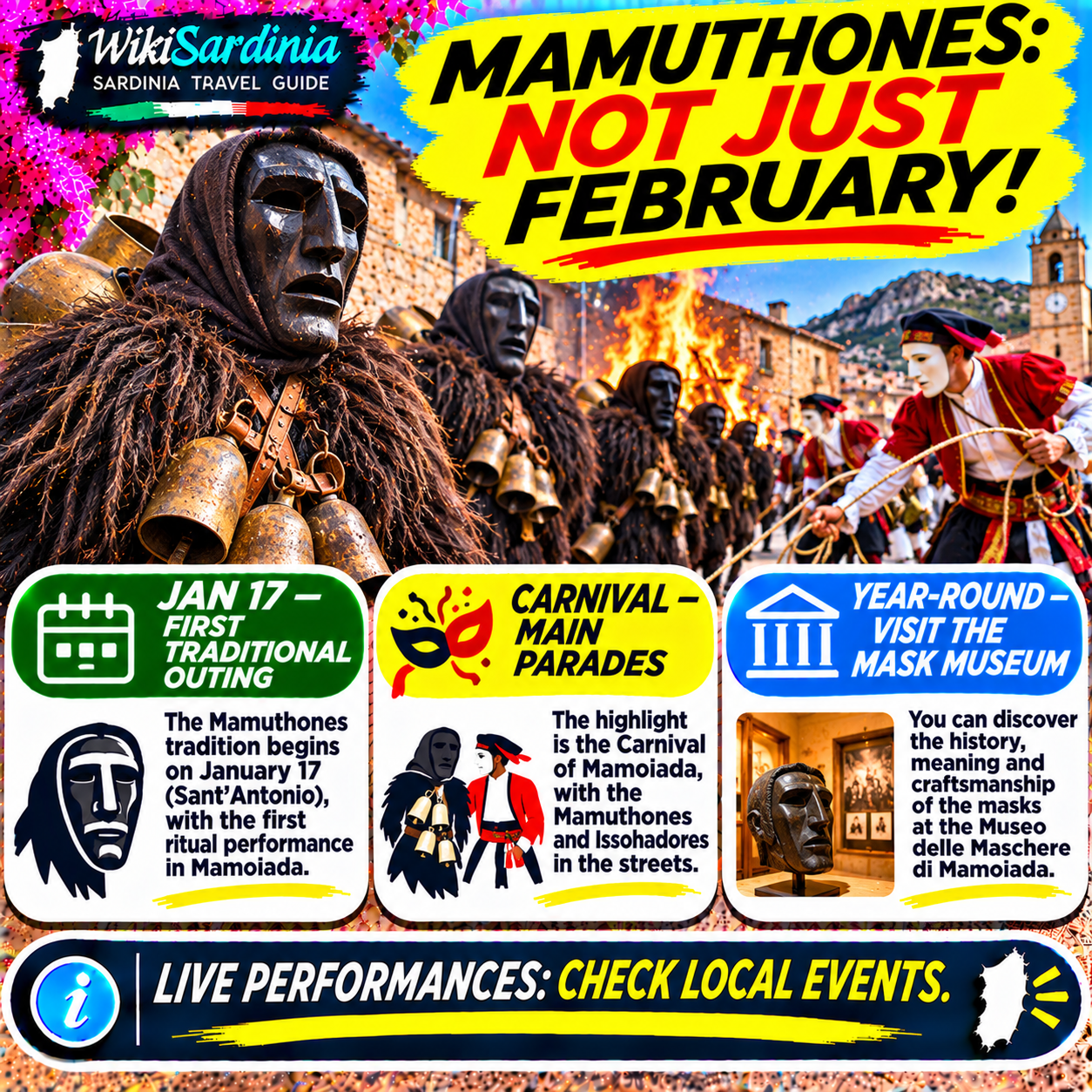
Mamuthones are among Sardinia's most extraordinary traditional masked figures. In Mamoiada, a village in the mountainous Barbagia area near Nuoro, performers wearing black wooden masks, dark sheepskins and heavy cowbells move together in a slow, rhythmic procession. They are accompanied by the brightly dressed Issohadores, who carry ropes and symbolically lasso spectators. Although the tradition is famous for its Carnival celebrations, you do not have to visit in February to learn about it: the first ritual appearance is associated with January 17, and the village's Museum of Mediterranean Masks offers an introduction outside festival season. Seeing an actual live procession at another time, however, requires checking a specific event calendar.
Who are the Mamuthones?
The Mamuthones are masked participants in a traditional ritual procession associated with Mamoiada. Their costume includes a dark wooden face mask called sa visera, a black sheepskin covering, dark clothing and a large set of bells attached to their backs. The village museum describes the bells as sometimes weighing up to 25 kilograms; other cultural descriptions give figures around 30 kilograms, reflecting variation in costume and reporting. The performers move in coordinated steps, producing a powerful repeated sound. The overall effect is solemn and mesmerizing rather than the cheerful fancy dress that many international visitors associate with Carnival.
Who are the Issohadores?
The Issohadores are the Mamuthones' companions and an essential part of the ceremony. Their costumes typically include a red upper garment, white clothing, an embroidered shawl, a distinctive headdress and a lighter-colored mask. They carry a rope called sa soha, which gives them their name. During processions they may symbolically catch spectators with the rope, a gesture traditionally interpreted as a good omen. Their more agile movements contrast with the measured, bell-heavy steps of the Mamuthones. Both groups together make up the distinctive Mamoiada ritual.
What does the ritual mean?
There is no single proven explanation for the ceremony's original meaning. Scholars and local interpreters have connected it to the agricultural year, pastoral life, fertility, protection from harmful forces and the changing seasons. Some hypotheses propose very ancient, pre-Christian roots, but the exact origin and age of the ritual cannot be established with certainty. The Museum of Mediterranean Masks also recounts an interpretation proposed by anthropologist Raffaello Marchi in 1951, linking the figures to a historical conflict; this remains one theory among several, not an established historical fact. The important point is that Mamoiada's community continues to maintain a living tradition whose meanings have evolved over time.
Do the Mamuthones appear only during February Carnival?
No. Carnival is their best-known annual celebration, but the ritual season traditionally begins with Sa Prima Essida, the first outing, associated with the feast of Sant'Antonio Abate on January 17. Bonfires are lit in the village and the masked groups move through its streets and neighborhoods. The main Carnival processions take place around Carnival Sunday and Shrove Tuesday, whose dates change each year and may fall in February or another nearby part of the calendar. There may also be appearances at cultural festivals or special organized events outside the Carnival period, but these are not guaranteed weekly or daily performances.
What happens on January 17?
On the feast of Sant'Antonio Abate, Mamoiada celebrates with traditional bonfires and the first public appearance of the masked groups. The ritual is locally known as Sa Prima Essida or Sa Prima Issida. Performers prepare and put on their masks and costumes before moving through the village as the bells sound. Italy's official tourism portal and the local museum identify January 17 as the key date. Some broader Sardinian cultural descriptions refer to festivities beginning on January 16, so travelers should check the precise schedule for Mamoiada in the year they intend to visit rather than assuming all ceremonies occur on one evening at a fixed hour.
What is Carnival in Mamoiada like?
The masked procession is not merely a parade of costumes. The synchronized steps and heavy bells create a strong physical rhythm, while the Issohadores move around the group and interact symbolically with spectators. The celebrations take place in the village streets, and local customs, community gatherings and other festivities form part of the atmosphere. The exact procession route, starting time, crowd arrangements and program are published for each edition. Visitors should not rely on an old year's timetable or assume that a group will pass every street.
Can I see Mamuthones in summer, spring or autumn?
You may be able to see a special performance, but it is not a standing daily attraction. Groups sometimes participate in cultural events, tourism initiatives or festivals outside the winter Carnival season. A summer visit to Mamoiada does not automatically include a live masked procession. Before planning your trip around one, ask the local tourism office, museum or recognized Mamuthones association whether an appearance is officially scheduled for your dates. Confirm the location, whether tickets are required and whether the event is a full traditional procession or a shorter cultural demonstration.
What can I see year-round at the Museum of Mediterranean Masks?
The Museo delle Maschere Mediterranee in Mamoiada displays traditional Mamuthones and Issohadores costumes and wooden masks, together with other Sardinian and Mediterranean masking traditions. Exhibits introduce the ritual through objects, photographs and audiovisual interpretation. The museum is a reliable cultural alternative when no procession is scheduled: you can appreciate the craftsmanship, symbolism and history without needing to travel during Carnival. The museum's own website currently lists opening on Wednesday through Monday from 10 AM to 6 PM, with Tuesday closed; its English page also lists a last-entry time of 5:45 PM, while the Italian page has a different last-entry detail. Confirm the current hours and last admission directly before visiting.
Where is the museum and how do I contact it?
The museum is at Piazza Europa 15, 08024 Mamoiada (NU). The museum system lists telephone +39 0784 1898135. For the most reliable information on tickets, guided interpretation, holiday closures and upcoming events, use the official Mamoiada Museum System website. A Ministry of Culture page still displays older and conflicting closure information; the museum operator's current site is the more appropriate source for visitor planning.
Can you visit workshops where the masks are carved?
Yes, Mamoiada has artisans who carve traditional wooden masks, and Italy's official tourism portal recommends exploring the local craft workshops. These visits can reveal how the distinctive faces are shaped from wood and how craftsmanship is passed on. A workshop is a working business, not automatically a free museum: contact the artisan to confirm whether visitors are welcome, whether demonstrations are available, opening hours and any purchase or fee expectations. Seeing a mask being carved is not the same as witnessing a full ceremonial performance.
Is Mamoiada worth visiting if there is no procession?
Yes, particularly if you are interested in Sardinia beyond its beaches. The village offers the mask museum, artisan workshops, traditional architecture and the surrounding cultural landscape of Barbagia. It is also associated with Cannonau wine and local food traditions. A museum visit followed by a walk through the village and an arranged artisan stop can make a worthwhile cultural outing. Just be clear about your expectations: seeing displayed masks is readily possible when the museum is open, whereas seeing a live Mamuthones procession depends on a scheduled event.
Where is Mamoiada?
Mamoiada lies inland in central Sardinia, near Nuoro and the Gennargentu mountain area. It is not a seaside resort, and reaching it from coastal bases requires planning. A rental car can make the visit more flexible, although visitors should check road conditions and weather in winter. If you are staying in Alghero, Olbia or Cagliari, consider whether the journey fits your available time; do not assume the village is a quick stop from every part of the island.
Are the Mamuthones frightening for children?
Some children find the black masks, animal skins and loud bells fascinating, while others may be frightened by the appearance, volume and crowds. Explain the costumes beforehand, watch from a comfortable distance and consider the museum if your child is sensitive to noise. The rope-catching gesture of the Issohadores is part of the ritual; follow performers' instructions and do not enter their path for photographs. Ear protection may be useful for visitors sensitive to loud sounds.
Can tourists take photographs?
Outdoor festival photography is often possible, but follow event restrictions, keep passageways clear and respect participants. Do not touch masks, bells, ropes or costumes without permission. Ask before photographing artisans at work, private dressing rituals or people in close-up. Museum photography rules may differ from those of street events, so check with staff. The ceremony is an important expression of community identity, not a staged attraction that visitors can interrupt.
How should I plan a visit outside Carnival?
- Check the official event calendar. Look at the Mamoiada Museum System, local associations and municipal announcements for your exact dates.
- Choose your experience. For a guaranteed introduction, plan around museum opening hours; for a live procession, wait for a confirmed event announcement.
- Contact a mask artisan. Ask whether a workshop visit or demonstration can be arranged.
- Allow time for the village. Explore Mamoiada's streets, local culture and food without assuming there will be a parade.
- Confirm logistics. Check event times, language, accessibility, tickets and transport before leaving your coastal base.
Useful Italian phrases
“Quando escono i Mamuthones?” — When do the Mamuthones appear? “Ci sono sfilate fuori dal Carnevale?” — Are there parades outside Carnival? “È prevista un'esibizione durante la nostra visita?” — Is a performance scheduled during our visit? “Il museo è aperto oggi?” — Is the museum open today? “Si può visitare un laboratorio di maschere?” — Can we visit a mask-making workshop? “La visita è disponibile in inglese?” — Is the visit available in English?
Official sources and further reading
Mamoiada Museum System — Carnival, Mamuthones and Issohadores; Mamoiada Museum System — museum collections, contacts and visitor hours; Italia.it — Mamoiada and the January 17 first outing; Italian Ministry of Culture — Carnival of Mamoiada; SardegnaTurismo — Mamoiada; Mamuthones association — ritual and dressing. The sources document the tradition and annual observances; they do not guarantee a live performance on an arbitrary travel date.
The WikiSardinia takeaway
Mamuthones are Mamoiada's solemn, bell-bearing masked performers, accompanied by the rope-carrying Issohadores. Their roots and meanings are debated, but the living tradition remains central to the village's identity. You can see them during the January 17 Sant'Antonio celebration and around Carnival, while other performances require checking specific event announcements. At any other time of year, the Museum of Mediterranean Masks and local mask-making workshops offer a meaningful way to discover the tradition without expecting a daily parade.