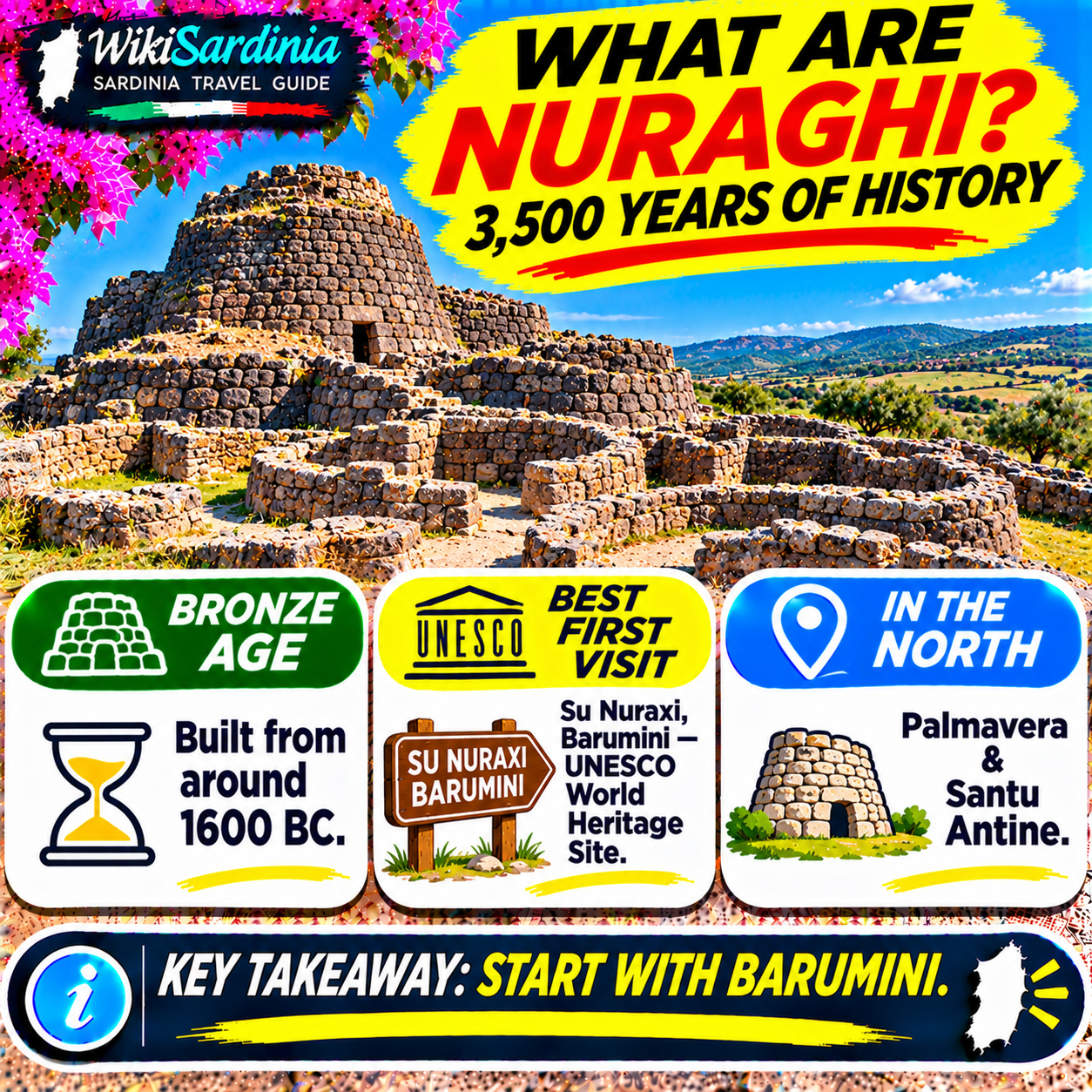
Nuraghi are Sardinia's extraordinary prehistoric stone towers, built mainly during the Bronze Age. They are not Roman castles, medieval watchtowers or natural rock formations. The oldest major examples date back roughly 3,500 years, and thousands survive across the island. If you have time for only one and are not an archaeology enthusiast, Su Nuraxi at Barumini is the strongest all-round choice: a UNESCO World Heritage Site with a monumental tower complex, an ancient village and an obligatory guided visit that helps bring the ruins to life.
What exactly is a nuraghe?
A nuraghe (plural nuraghi) is a monumental tower built from large stone blocks, usually stacked without mortar. Many have a circular footprint, tapering exterior walls and interior rooms roofed with a corbelled or tholos-like stone vault. Some are single towers; others grew into elaborate multi-tower complexes surrounded by defensive walls, courtyards, wells and settlements. These monuments are unique to Sardinia in their characteristic form. The people who built them are conventionally called the Nuragic civilization, but their lives were more complex than a single monument type suggests.
How old are nuraghi?
UNESCO dates the characteristic monumental nuraghi to the Middle and Late Bronze Age, around 1600–1200 BCE. That makes the earliest major examples approximately 3,500 years old today. Construction, rebuilding and occupation continued over many centuries. At Barumini, the principal tower was built during the second millennium BCE and the surrounding settlement evolved through later periods. Do not assume every visible wall at a site was built in the same year: a complex can preserve several construction phases and evidence of later Punic and Roman use.
What were nuraghi used for?
Archaeologists generally interpret many nuraghi as defensive, residential, social or political centers, but their precise functions varied and are still debated. Their imposing height, controlled entrances and commanding positions suggest defense and status. Some may have served local elites or kin groups, while nearby settlements supported everyday community life. It is too simplistic to claim that every nuraghe was exclusively a fortress, temple, palace or astronomical observatory. The UNESCO description emphasizes the changing social and defensive roles of the structures as Sardinian communities became more complex.
How many nuraghi are there in Sardinia?
The Municipality of Barumini reports more than 7,000 recorded nuraghi across Sardinia, including single towers and complex sites. Counts can vary according to the inventory, preservation and definition used. Some are monumental visitor attractions, while others are small ruins visible in fields or on hillsides. Not every structure is open to the public, safe to enter or accessible from a road.
Which nuraghe is best for a first-time visitor?
Su Nuraxi di Barumini is the best overall introduction for most first-time visitors. UNESCO calls it the most complete and outstanding example of Sardinia's distinctive Bronze Age nuraghi. Instead of seeing only an isolated tower, you can explore the relationship between the central fortress, surrounding towers and a settlement of circular huts. The complex was excavated in the twentieth century by archaeologist Giovanni Lilliu and entered the UNESCO World Heritage List in 1997. Its scale is visually impressive even if you have never read a book about archaeology.
What will you see at Su Nuraxi?
The site features a massive central tower, originally more than 18 meters high, enclosed by four subsidiary towers linked by thick stone walls. Remains of a further defensive enclosure and an extensive village surround the complex. As you walk through the site, the architecture helps explain why a nuraghe was more than a pile of ancient stones. A guide can point out entrances, chambers, passages and later building phases, making it easier to imagine the people who lived and worked there.
Do you need a guide at Barumini?
Yes. The Italian Ministry of Culture states that Su Nuraxi can be visited only with an accompanying guide for safety reasons. This is a benefit for travelers who are not archaeology specialists, because someone explains what they are looking at. The local managing organization, Fondazione Barumini Sistema Cultura, is responsible for current visiting arrangements, ticket prices, schedules and exemptions. Check its official website before setting off: Fondazione Barumini Sistema Cultura. The published site description does not guarantee that every departure includes an English-speaking guide, so ask specifically when booking or at the ticket office.
Is Barumini suitable for children or people with limited mobility?
Many children find the towers and passageways fascinating, but the archaeological terrain includes uneven stones, steps and potentially narrow or confined spaces. A stroller or wheelchair cannot be assumed to reach every part of the monument, even if parking or visitor facilities are accessible. Ask the operator about the precise route and possible alternatives before purchasing tickets. Wear sturdy, closed-toe shoes, supervise children and follow the guide's instructions. In summer, bring water and sun protection because exposed areas can be hot.
How long should you allow for Barumini?
Allow approximately an hour for the guided archaeological visit, plus time for arrival, waiting, parking and any museum stops. If you want to explore the nearby Casa Zapata Museum and the Giovanni Lilliu Centre, plan a longer outing. These additional venues help explain the Nuragic world through artifacts and displays. Check whether a combined ticket is offered on your travel date and which sites it includes; do not rely on old online ticket prices.
Is Barumini worth the drive from the coast?
For many visitors, yes—especially if you are staying in southern Sardinia or want a major cultural excursion beyond the beaches. Barumini lies inland in the Marmilla area, roughly 60 kilometers from Cagliari according to Italy's official tourism portal. The actual driving time depends on your starting point and road conditions. If you are based in Alghero or far northern Sardinia and have only a short holiday, one of the northern sites may be a more practical choice than a long cross-island trip.
Best alternative near Alghero: Nuraghe Palmavera
Nuraghe Palmavera is an excellent choice for travelers staying in Alghero, Fertilia or the Porto Conte area. The archaeological complex includes stone towers and remains of an associated settlement, making it easier to understand Nuragic community life than at a solitary tower. It can be combined with a day exploring the Alghero coast. Check the operator's current opening hours, ticket conditions and whether guided interpretation is available. It is not a UNESCO World Heritage Site, and its smaller scale is different from Barumini's extensive fortified village.
Best northern choice for impressive architecture: Santu Antine
Nuraghe Santu Antine, near Torralba in northern Sardinia, is among the island's most impressive multi-tower complexes. Its towering stone architecture, interior corridors and surviving chambers offer a powerful sense of Bronze Age engineering. It is especially rewarding for visitors who enjoy walking through ancient structures. Its location makes it a useful option for people exploring the Sassari and Logudoro area. Confirm opening arrangements and access restrictions before visiting.
Which site should you choose?
If you want the most complete introduction and a guided explanation, choose Su Nuraxi at Barumini. If you are staying in Alghero and want a convenient first experience, choose Palmavera. If you want dramatic stone architecture in northern Sardinia, consider Santu Antine. None is objectively “best” for every traveler: your base, mobility, available time and interest in history matter more than collecting famous names.
Are nuraghi older than Roman ruins?
Yes, the principal Nuragic building period predates Rome's imperial monuments by well over a millennium. Some Nuragic sites remained occupied or were reused in Punic and Roman times, however, so the presence of Roman-era finds does not mean the original tower was built by Romans. Sardinia's ancient history has multiple layers, and a guided visit is often the easiest way to distinguish them.
Did the Nuragic people build the Giants' Tombs?
Nuragic Sardinia also produced other distinctive monuments, including tombe dei giganti (Giants' Tombs), collective burial structures. These are not giant-sized human graves and do not prove the existence of a race of giants. They belong to the island's prehistoric funerary tradition. Sacred wells and other ritual sites also offer insight into Nuragic society beyond the towers.
Do you need to book ahead?
Check each site's current official visitor information, particularly in peak season, on holidays and when traveling with a group. At Barumini, guided access is mandatory, but that does not establish a universal advance-booking requirement or guarantee a departure at your preferred time. Ask about English-language tours, admission prices, the last entry and whether bad weather affects access. This guide does not confirm live ticket inventory.
What should you bring?
Comfortable closed-toe shoes with grip, drinking water, sun protection and a light layer for cooler interior spaces are sensible. Avoid climbing on unmarked walls, moving stones or entering closed passages. Archaeological sites are protected heritage, and loose stones or exposed edges can be hazardous. Photography rules, drone restrictions and any temporary closures should be checked with the site operator.
Useful Italian phrases
“È disponibile una visita guidata in inglese?” — Is an English guided tour available? “Quanto dura la visita?” — How long does the visit last? “Bisogna prenotare?” — Do we need to book? “Il percorso è adatto ai bambini?” — Is the route suitable for children? “Ci sono scale o passaggi stretti?” — Are there stairs or narrow passages? “Qual è l'ultimo ingresso?” — What time is the last admission?
Official sources
UNESCO World Heritage Centre — Su Nuraxi di Barumini; Italian Ministry of Culture — UNESCO description; Sardinian National Museums — Su Nuraxi and mandatory guided visits; Municipality of Barumini — archaeology and historical chronology; Fondazione Barumini Sistema Cultura — current visitor information; Italia.it — Barumini travel context. Archaeological interpretations are based on current scholarship; site hours, ticket prices and language availability require direct confirmation.
The WikiSardinia takeaway
Nuraghi are Sardinia's 3,500-year-old Bronze Age stone towers, and you do not need to be an archaeologist to enjoy them. Start with UNESCO-listed Su Nuraxi at Barumini if your itinerary allows: its guided visit and surrounding village make the ancient civilization easier to imagine. If you are staying near Alghero, Palmavera is a convenient alternative; in the north, Santu Antine is outstanding for its monumental architecture. Visit at least one—Sardinia's history is as extraordinary as its coastline.