Carignano del Sulcis is one of Sardinia's signature wines, made from Carignano grapes grown in the island's far southwest. Some of its most remarkable vineyards stand in sandy coastal soils near Sant'Antioco and Calasetta, where low, gnarled vines can look almost as though they are growing directly out of a beach. But this is not a story about planting grapes on every protected sand dune. It is a story about a Mediterranean variety adapted to dry, windy ground—and sandy vineyards that helped preserve unusually old vines on their own roots.
What exactly is Carignano del Sulcis?
Carignano is a red grape variety known elsewhere in the Mediterranean as Carignan or Cariñena. Carignano del Sulcis DOC is the protected wine designation for wines produced in a defined part of southwestern Sardinia. Under its production rules, Carignano must account for at least 85% of the grape blend. The designation includes red, rosé, riserva, superiore and other specified styles; it is not one single bottle or one winery's brand. The DOC dates to 1977. See the regional agricultural agency LAORE's DOC overview and the official production specification.
Why does Carignano grow in sand so close to the sea?
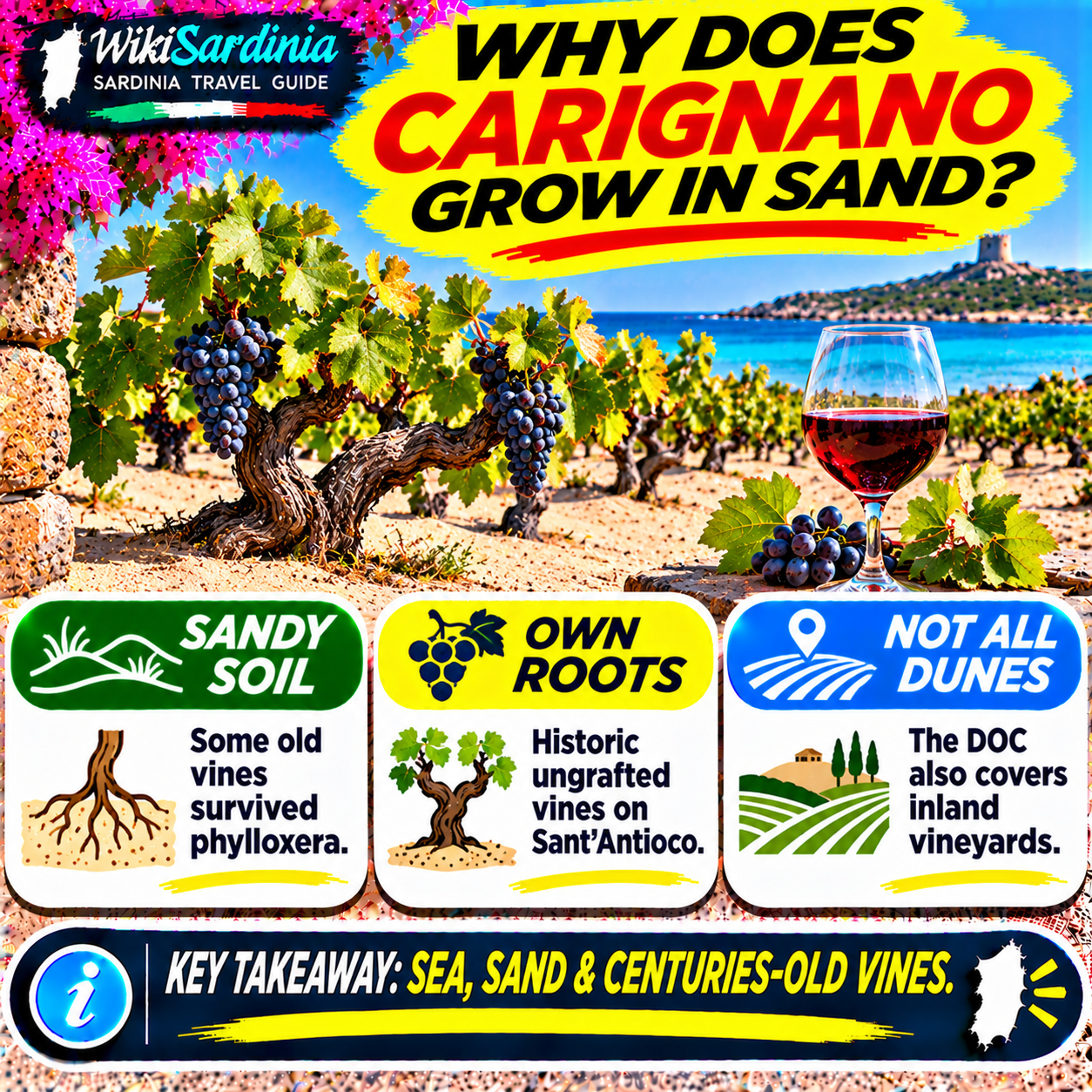
Parts of the Sulcis coast have deep, free-draining sandy soils, hot summers and persistent sea breezes. Carignano has long been cultivated in these conditions, often as a compact, low bush vine known as alberello. The low shape can help reduce exposure to strong winds, while careful pruning and established roots help vines cope with relatively poor soils and seasonal drought. Coastal conditions are not automatically easy: sand can hold less water and fewer nutrients than richer soils, and salt-laden winds can stress plants. Growers manage these challenges rather than simply benefiting from them.
What does sand have to do with phylloxera?
The most extraordinary feature is the survival of some ungrafted vines, known in Italian as viti a piede franco. In the late nineteenth century, the root-feeding pest phylloxera devastated vineyards across much of Europe. Most modern European wine vines are therefore grafted onto resistant American rootstocks. In certain very sandy soils, phylloxera has struggled to establish damaging populations. The official Carignano del Sulcis specification specifically notes that sandy areas of Sant'Antioco allowed vines on their original roots to survive without the same phylloxera damage. This does not mean that all sand is pest-proof or that every Carignano vineyard is ungrafted.
Are the vineyards literally planted in beach dunes?
Some are close enough to the coast to resemble dune landscapes, and the Sulcis has sandy coastal vineyards, especially around Sant'Antioco. But not every vineyard grows on an active beach dune, and protected coastal dunes are sensitive ecosystems, not open land for casual planting or driving. The DOC also includes inland, alluvial, rocky and other soils. The regional agency identifies vineyards near Porto Pino, while Cantina di Calasetta describes its sandy seaside vineyards on Sant'Antioco. Treat “wine grown in the dunes” as a vivid description of certain coastal sites, not a rule for the entire denomination.
Where are the best-known sandy vineyards?
Sant'Antioco and Calasetta are especially associated with coastal sand and old ungrafted Carignano vines. The island of Sant'Antioco is connected to mainland Sardinia by a road causeway, making it accessible without a ferry. Porto Pino is another area associated with sandy vineyards and coastal scenery. The broader DOC territory also includes Santadi, Giba, Carbonia, Carloforte, Teulada, Sant'Anna Arresi and other municipalities. Not all vineyards in these places have the same soil, age or growing method.
How old are the vines?
Some producers report very old bush vines, including examples approaching or exceeding a century. Cantina di Calasetta says some of its traditional coastal vines reach about 100 years of age. That is a producer statement about particular vineyards, not a claim that all Carignano vines are century-old. Old vines often yield relatively small crops, but age alone does not guarantee a better wine: farming, vintage conditions and winemaking still matter.
Does the salty sea air make the wine taste salty?
Wine descriptions often use words such as saline, savory or mineral to evoke coastal freshness. However, it is misleading to suggest that sea salt simply travels through the vine and directly flavors the wine like seasoning. The sensory result reflects grape composition, ripeness, climate, soil-water conditions and winemaking. Coastal winds and temperatures can affect the growing environment, but tasting “the sea” is partly a metaphor. The DOC specification describes the wines as dry, harmonious and often savory, rather than establishing a direct salt-transfer mechanism.
What does Carignano del Sulcis taste like?
A typical red Carignano del Sulcis may offer ripe cherry, plum, blackberry, Mediterranean herbs, spice and a warm, structured palate. Tannins can be supple or firmer depending on the style and producer. A youthful red may emphasize fruit, while a riserva or wood-aged bottling may show additional spice and complexity. Rosato versions are generally fresher and lighter in feel. Alcohol levels and body vary: check the bottle label rather than assuming every Carignano is equally powerful.
Is it the same grape as Cannonau?
No. Carignano and Cannonau are distinct varieties, even though both produce important Sardinian reds. Cannonau is associated with Grenache and is widely grown across Sardinia. Carignano is especially tied to the southwest and belongs to the broader Carignan family. Both can make rich Mediterranean reds, but their aromas, structure and local expressions differ. If you enjoy one, trying the other is an excellent way to compare Sardinian wine regions.
Why are the vines so low to the ground?
Traditional alberello training keeps vines compact and relatively close to the soil. In windy coastal sites, a lower canopy can be easier to manage than tall, exposed rows. It also reflects long-standing local viticultural practice and the need to balance vine growth in dry, low-fertility soils. Some newer or more fertile vineyards use supported training systems, so the classic bush-vine appearance is not universal across the DOC.
How did Carignano arrive in Sardinia?
The exact route is debated. Historical accounts link the grape to ancient Mediterranean trade, with Phoenician or Carthaginian introductions frequently suggested; other explanations emphasize later connections with Spain. The official specification acknowledges the variety's long presence across the western Mediterranean but does not establish a single certain arrival date. Presenting one ancient civilization as definitively responsible would overstate the evidence.
Which wines and wineries can visitors explore?
For a starting point, consider Cantina di Calasetta on Sant'Antioco, which highlights its sandy ungrafted vineyards, and Cantina Santadi, a major producer whose official materials explain the regional grape and its history. Other producers and small estates work with Carignano across the Sulcis. A winery's website can help you identify its wine shop and tasting formats, but a vineyard visit, cellar tour or tasting may require advance booking. Contact the producer directly for opening hours, language options, prices and availability; none are guaranteed by the presence of a website.
Can you visit the sandy vineyards yourself?
Some can be seen from public roads or through organized winery experiences, but most vines grow on private agricultural land. Do not enter vineyard rows, pick grapes or walk over sensitive dune vegetation without permission. Ask for a guided vineyard visit if you want to see old piede franco vines up close. In summer, bring water, sun protection and suitable shoes; sandy fields can be hot and exposed.
What foods pair with Carignano?
A full-bodied red Carignano can work with roast lamb, grilled meat, hearty stews, aged pecorino and richly flavored Sardinian dishes. A lighter red or rosato may suit charcuterie, tomato-based dishes or a casual seaside meal. Food pairing is a preference, not a rule. If you are driving between wineries or beaches, designate a non-drinking driver or arrange transport in advance.
What should you ask at a tasting?
Ask whether the bottle comes from sandy coastal soils or inland vineyards; whether the vines are ungrafted (a piede franco); the approximate vine age; whether it is a single-vineyard wine or a blend; and whether the wine was aged in steel, concrete or wood. These questions help you understand the wine more accurately than assuming every Carignano tastes of salt or comes from a beach.
Useful Italian phrases
“Questo Carignano viene da vigne sulla sabbia?” — Does this Carignano come from sandy vineyards? “Le viti sono a piede franco?” — Are the vines ungrafted? “Quanti anni hanno le viti?” — How old are the vines? “È possibile visitare il vigneto?” — Can we visit the vineyard? “Serve prenotare la degustazione?” — Do we need to reserve the tasting? “Qual è la differenza tra il rosso e la riserva?” — What is the difference between the red and the riserva?
Official sources
Italian Ministry of Agriculture — Carignano del Sulcis DOC production specification; LAORE Sardegna — DOC requirements and production area; LAORE Sardegna — Carignano, including Porto Pino vineyards; Valoritalia — denomination information; Cantina di Calasetta — sandy coastal vineyards and own-rooted vines; Cantina Santadi — Carignano and the Sulcis landscape. These sources document the DOC, geography and historic sandy vineyards; they do not establish that every Carignano wine comes from active dunes or that all vines are ungrafted.
The WikiSardinia takeaway
Carignano del Sulcis is the red wine of southwestern Sardinia, and its coastal sandy vineyards preserve a remarkable chapter of European wine history. In places such as Sant'Antioco, sand helped some vines survive phylloxera on their original roots. The sea, wind and poor soils shape a distinctive growing environment, but the DOC extends far beyond beach-like vineyards. For visitors, tasting Carignano and seeing a permitted old-vine site are wonderful ways to connect the island's wine with its landscape.