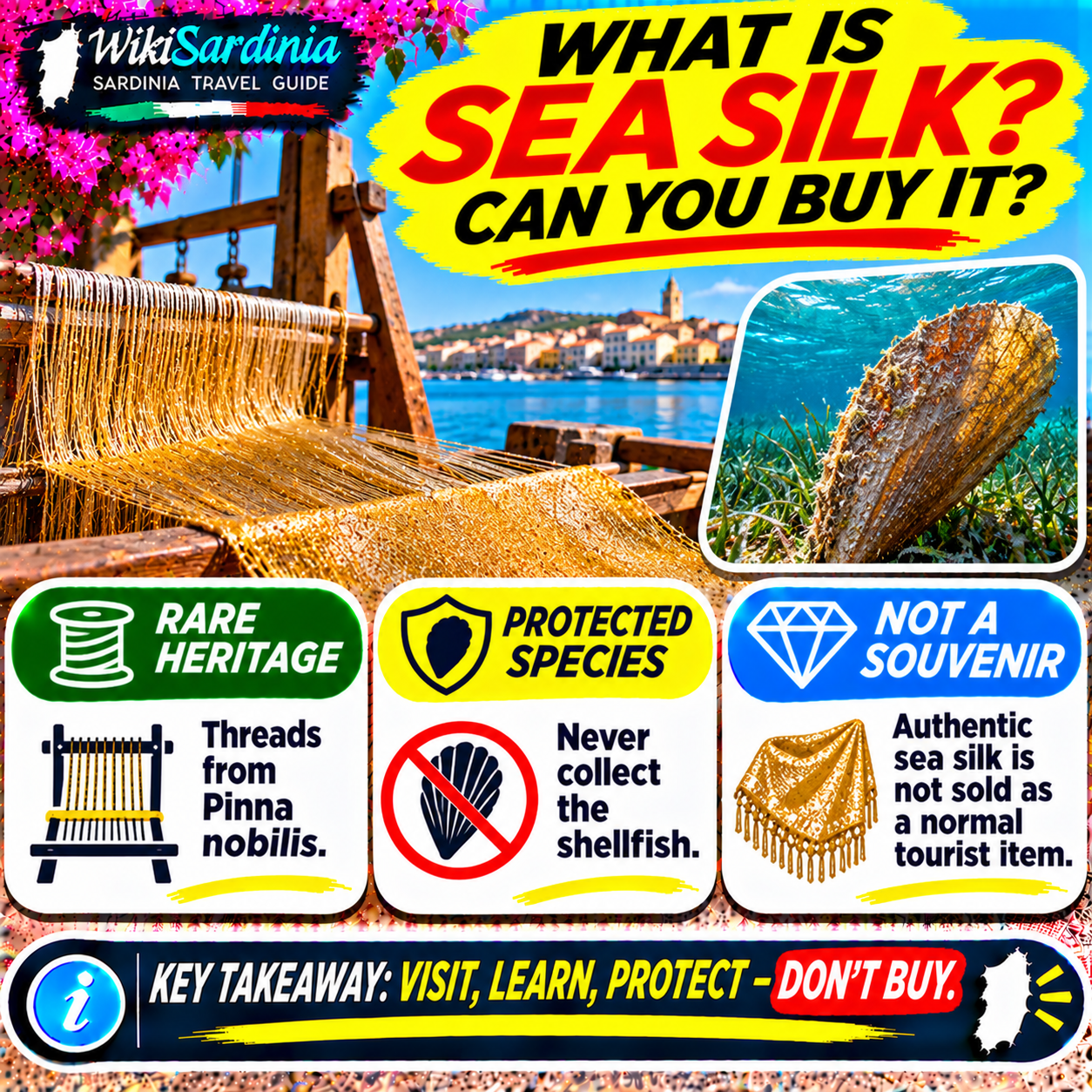
Sea silk, known in Sardinia as bisso marino, is an extraordinarily rare textile made from the silky anchoring filaments of the Mediterranean noble pen shell, Pinna nobilis. The island of Sant'Antioco in southwestern Sardinia is particularly associated with its traditional processing and weaving. But travelers should know the essential distinction before visiting: authentic sea silk is not a normal souvenir to buy. The mollusc is strictly protected, and the best way to appreciate the tradition is through museums, historical pieces and the people preserving the craft—not by shopping for newly harvested material.
What exactly is sea silk?
Pinna nobilis, also called the noble pen shell or fan mussel, is a large Mediterranean bivalve that lives partly embedded in the seabed. It produces a bundle of strong, fine fibers, called a byssus, to anchor itself in place. Historically, these fibers were cleaned, combed, spun and sometimes woven or embroidered into a lustrous, golden-brown textile. The fabric is called sea silk because of its appearance and texture; it is not silk made by silkworms and should not be confused with ordinary seaweed fiber.
Why is Sant'Antioco famous for it?
Sant'Antioco, in the Sulcis area of southwestern Sardinia, has a long local tradition of processing marine byssus. Its coastal environment historically supported Pinna nobilis, while knowledge of spinning and weaving passed through local families and workshops. The Sardinian coastal conservation agency has documented the area's marine ecology and the importance of the tradition. Today Sant'Antioco is associated especially with Chiara Vigo, a textile practitioner who preserves and demonstrates aspects of sea-silk craftsmanship. The Italian Ministry of Culture's ethnographic catalogue records her work and its cultural significance.
How is byssus transformed into golden thread?
Historically, the raw filaments were painstakingly cleaned of salt and debris, combed, softened, spun and worked into embroidery or textile structures. The transformation is labor-intensive, and the resulting material is exceptionally scarce. Its warm gold-like sheen is one reason sea silk became famous. The precise methods used by individual artisans can differ, and not every demonstration involves processing newly obtained material. Given the conservation status of the source animal, visitors should not assume that historic descriptions of collection are a legal or appropriate instruction to harvest it today.
Is Pinna nobilis protected?
Yes. The noble pen shell is a protected Mediterranean species, and conservation has become especially urgent because populations have suffered severe mortality events. The species is protected under European and Mediterranean conservation frameworks. Visitors must not collect, damage, remove or disturb living pen shells, and should not take shells or anchoring fibers from the seabed as souvenirs. Rules governing possession, provenance and trade are complex; any proposed purchase should be assessed against the applicable wildlife protections rather than relying on a seller's assurances. See the Sardinian Coastal Conservation Agency's A-BISSO project and the Italian Ministry of Culture's documentation.
Can you actually buy authentic sea-silk items?
Do not expect to buy a genuine sea-silk scarf, bracelet or embroidered souvenir in a tourist shop. Authentic historic examples are extremely rare, and the protection of Pinna nobilis makes newly sourced material a serious conservation and legal concern. Some old pieces exist in museum and private collections, but their existence does not establish that unrestricted trade is permitted. A claim that a product is “real Sardinian sea silk” should be treated cautiously: ask for independent evidence of material identification, lawful provenance and the seller's right to transfer it. For an ordinary tourist, the practical recommendation is to appreciate sea silk as heritage, not as a shopping category.
Does Chiara Vigo sell her work?
No, according to her stated tradition. Chiara Vigo says that sea silk is not bought or sold and that her work is given rather than commercially traded. Her official website explains that she regards the craft as a responsibility to preserve and share, and the Ministry of Culture's ethnographic documentation describes the same non-commercial commitment. Do not arrive expecting a price list for a sea-silk scarf or offering money in exchange for a piece. The existence of voluntary donations to support cultural work does not turn the objects into merchandise. See Chiara Vigo's official website and her explanation of the tradition.
Where can you learn about sea silk in Sant'Antioco?
The Museo del Bisso, associated with Chiara Vigo, is at Via Regina Margherita 168, Sant'Antioco. It is described as a museum-workshop centered on the traditional craft and its cultural meanings. Before traveling, contact the museum to verify current opening arrangements, whether visits or demonstrations are available, whether booking is required and whether English explanations can be provided. Its website is chiaravigo.it. Do not assume that a workshop will be operating at any particular hour.
Is there another museum option?
Yes. The METS — Museo Etnografico di Sant'Antioco, also known as Su Magasinu 'e su Binu, presents traditional local crafts and includes an exhibition on Pinna nobilis and the historical production of sea silk. The Municipality of Sant'Antioco's cultural documentation confirms this exhibition. It is a useful option for visitors who want to understand the craft in the wider context of island life, alongside traditional weaving, farming and other trades. Confirm opening hours, tickets and exhibit access with the museum's current operator.
Is sea silk the same as the “byssus” mentioned in ancient texts?
Not necessarily. This is an important historical distinction. The Natural History Museum Basel's sea-silk research project explains that the word byssus in antiquity and through the Renaissance often referred to exceptionally fine linen. The term was later applied to the fibers of the pen shell, creating confusion in modern claims about ancient fabrics. Stories that a particular ancient robe, biblical garment or Egyptian textile was definitely made from Mediterranean sea silk need material and documentary evidence. See the Natural History Museum Basel's Sea-Silk Project.
How rare are surviving pieces?
They are extremely rare. The Natural History Museum Basel reports an inventory of roughly 60 historical examples dating from the fourteenth to the mid-twentieth century in its research project. That number is a research inventory, not a claim that exactly 60 sea-silk objects exist worldwide. Scarcity reflects the demanding production process, the limited surviving historical record and the difficulty of reliably identifying fibers. This rarity is another reason tourists should be skeptical of mass-produced “genuine sea silk” souvenirs.
Is the sea silk gold-colored because it contains gold?
No. The material's luminous golden-brown appearance comes from its natural fibers and how they reflect light, not from gold metal. Its color can change with cleaning, treatment, age and illumination. A golden appearance alone is not a reliable test of authenticity: synthetic or ordinary textile fibers can also be made to look shiny and gold.
Can you buy souvenirs inspired by sea silk?
Yes, you may find books, postcards, museum materials or contemporary textiles inspired by the tradition, depending on what local venues and shops offer. These can be appropriate souvenirs as long as they are honestly described and do not claim to contain protected marine material. If a scarf or textile is made from silk, linen, wool or synthetic fibers, it should be sold under its actual material description. Buying a book about the craft or supporting a legitimate museum is a much more straightforward way to remember the experience.
Can visitors watch sea-silk weaving?
Possibly, but do not assume there is a daily public demonstration. Museum-workshop activities, private teaching and special events may depend on the practitioner's availability and conservation considerations. Contact the relevant venue in advance and ask whether the visit includes a live demonstration, a historical explanation, a display of existing works or a combination of these. A demonstration can be meaningful even without fresh marine fibers being collected.
How do you get to Sant'Antioco?
Sant'Antioco is in southwestern Sardinia and is connected to the main island by a road causeway, so visitors can reach the town without taking a ferry. It can be combined with a trip through the Sulcis area, including Calasetta and coastal scenery. Travel times vary substantially depending on whether you are based in Cagliari, Alghero, Olbia or elsewhere. Check the museum's actual visitor arrangements before making a dedicated long-distance journey.
What should you ask before visiting?
Ask whether the museum is open on your chosen date, whether visits require reservations, whether there is a charge or a voluntary donation, whether English-language explanations are available and whether the route is suitable for visitors with limited mobility. Also ask whether photography is permitted, especially of artworks and demonstrations. The museum is a place of cultural practice rather than an ordinary souvenir outlet, so approach the visit with curiosity and respect.
What if a shop offers “authentic sea silk” for sale?
Ask for the precise fiber composition, the species from which it came, its date of manufacture, documented provenance and evidence that possession and sale comply with applicable conservation laws. Do not accept vague claims such as “ancient technique” or “from the sea” as proof. If the material is claimed to be newly harvested Pinna nobilis byssus, that is a particularly strong reason to avoid the purchase. A normal receipt does not establish lawful origin, and carrying a protected-species product across international borders may create further problems. When in doubt, leave it.
Useful Italian phrases
“Che cos'è il bisso marino?” — What is sea silk? “Questo tessuto è davvero fatto con la Pinna nobilis?” — Is this fabric really made from Pinna nobilis? “Si può visitare il Museo del Bisso?” — Can we visit the Sea-Silk Museum? “È possibile vedere una dimostrazione di tessitura?” — Is it possible to watch a weaving demonstration? “Serve prenotare?” — Do we need to book? “Questo articolo è ispirato al bisso o contiene bisso autentico?” — Is this item inspired by sea silk or does it contain authentic sea silk?
Official and research sources
Chiara Vigo — official museum and craft website; Chiara Vigo — why her works are not sold; Italian Ministry of Culture — ethnographic record of sea-silk weaving; Sardinian Coastal Conservation Agency — A-BISSO and Pinna nobilis protection; Natural History Museum Basel — sea-silk research and terminology; University of Cagliari — sea-silk oral history and legal protection. Visitor hours and individual purchase or possession circumstances should be checked with the operator and competent authorities.
The WikiSardinia takeaway
Sea silk is one of Sant'Antioco's most fascinating traditions, but it is heritage to experience, not a product to hunt for. Its golden fibers historically came from the protected Pinna nobilis shellfish, and Chiara Vigo explicitly does not sell her sea-silk works. Visit the museum-workshop or the ethnographic museum to understand the technique, admire historic examples and learn why protecting the Mediterranean ecosystem matters. For a souvenir, choose an honest modern craft inspired by the tradition rather than a questionable claim of genuine newly sourced sea silk.