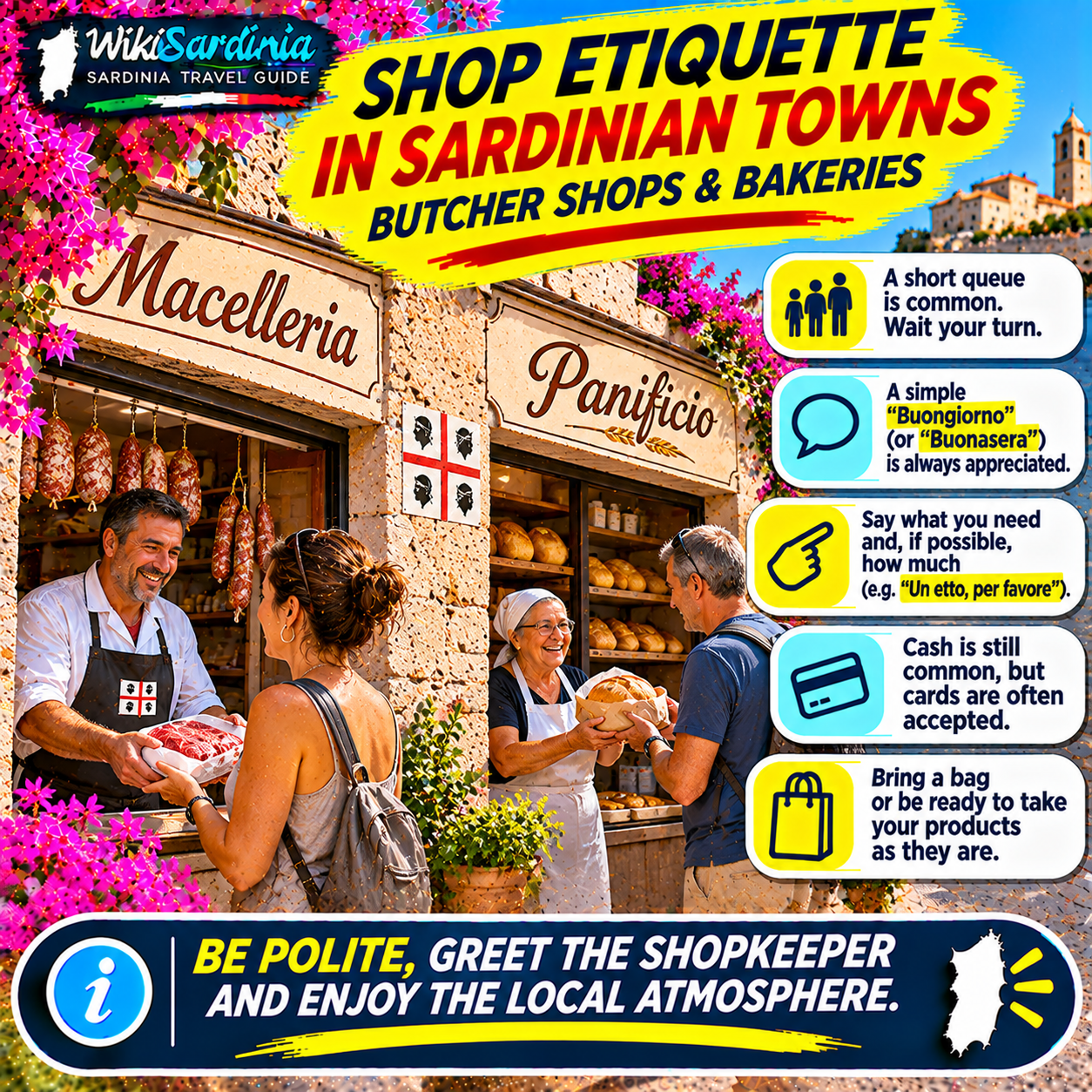
Stepping into a small macelleria (butcher shop) or panificio (bakery) is one of the pleasures of exploring Sardinia's inland villages. You do not need to know a complicated local ritual: greet the shopkeeper, work out whose turn it is, ask for what you need, and let staff handle food sold from behind the counter. The pace may feel more personal than at a supermarket, but practices vary between shops and towns.
What should I say when I walk in?
Start with “Buongiorno” (good morning or good day), or “Buonasera” (good evening, often used from late afternoon). When leaving, “Grazie, arrivederci” is a friendly goodbye. You do not have to speak Sardinian or perfect Italian. A polite greeting and patience matter much more than pronunciation.
How do I know whose turn it is?
First look for a numbered-ticket dispenser, sometimes marked prendi il numero. If there is one, take a ticket and watch the display or listen for your number. If there is no machine and customers are gathered loosely near the counter, ask “Chi è l'ultimo?” (“Who's last?”). Someone may identify themselves, allowing you to wait behind them. This is a common Italian queuing custom, not a rule used in every shop. Do not assume the person standing closest to the counter is next.
Can I pick up bread or meat myself?
Follow the shop's display and hygiene arrangements. Bread or other items placed on self-service shelves may be intended for customers to select, sometimes using provided tongs or gloves. Meat, sliced cold cuts and food displayed behind a staffed counter should be requested from the seller rather than handled. Ask “Posso prenderlo io?” (“May I take it myself?”) if you are unsure. Do not reach across the counter or touch unpackaged food without permission.
How do I order at a Sardinian bakery?
Point politely to the bread you want and ask its name if you are curious. Depending on the bakery, you may find pane carasau, pane civraxiu, spianata or other local specialties, but no single shop stocks all of them. You can ask “Vorrei questo pane, per favore” (“I'd like this bread, please”), or “Ne posso avere mezzo chilo?” (“May I have half a kilo?”) when sold by weight. Some loaves are sold by piece and others by weight, so ask before assuming.
How do I order in a macelleria?
Tell the butcher what you want to cook and how many people you are feeding. For example, “Vorrei quattro fettine per due persone” (“I'd like four slices for two people”), or “Mi consiglia un taglio per la griglia?” (“Can you recommend a cut for grilling?”). Some shops offer prepared items, sausages and regional specialties. Ask about ingredients and cooking methods rather than assuming a product is ready to eat. Fresh raw meat needs appropriate refrigeration and thorough handling.
What do 'un etto' and 'mezzo chilo' mean?
In Italian food shops, un etto is 100 grams, due etti are 200 grams, and mezzo chilo is 500 grams. This is particularly useful when buying sliced cured meats, cheese or other products sold by weight. A kilo is approximately 2.2 pounds. You can ask for a smaller amount if you only want to sample something. The shopkeeper may weigh the final portion and tell you the price.
Is it acceptable to ask about prices before ordering?
Absolutely. Look for displayed prices and ask “Quanto costa al chilo?” (“How much per kilogram?”) or “Quanto viene in tutto?” (“How much is it altogether?”). Some products are sold per item rather than per kilo. Asking for a price is normal; there is no need to haggle over ordinary posted retail prices. If the final amount is more than expected, politely clarify the weight and unit price before paying.
Should I chat with the shopkeeper?
A brief exchange is welcome when the shop is not busy. Asking what bread is traditional in the area or how to cook a particular cut can lead to useful recommendations. But do not feel obliged to make conversation, and avoid holding up a line while others are waiting. The tone differs by individual and place; not every rural shop is a social gathering spot.
Can I take photos inside?
Ask permission before photographing staff, other customers or the interior, particularly in a small independent business. “Posso fare una foto?” means “May I take a photo?” Avoid photographing payment details or people who have not agreed. Some shops may welcome a picture of their products; others prefer not to be photographed.
Can I pay by card, Apple Pay or cash?
Many Italian retailers accept electronic payments, but do not assume that every terminal, mobile wallet or foreign-issued card will work at the moment you visit. Ask “Posso pagare con carta?” (“Can I pay by card?”). Carry a modest amount of euro cash as a backup, especially in rural areas. A shop may have a technical problem with its POS, but that is different from claiming that small purchases must legally be paid in cash. Check the displayed amount and request your receipt (scontrino).
Should I bring my own shopping bag?
A reusable bag is practical for bread and packaged groceries. The shop may supply suitable food wrapping or a bag according to the product and its policies. Keep raw meat separate from ready-to-eat foods, and refrigerate perishables promptly, particularly in Sardinia's summer heat. Do not put unpackaged raw meat directly into a reusable shopping bag.
What if I have food allergies or dietary restrictions?
Ask clearly before buying. In a bakery, products may contain wheat, milk, eggs, nuts or other allergens; in a butcher shop, seasoned or prepared foods may contain ingredients beyond meat. For example, “Contiene latte, uova o frutta a guscio?” asks whether a product contains milk, eggs or nuts. EU food-information rules require allergen information for relevant non-prepacked foods, but the method of providing it can vary. If you have a serious allergy, confirm ingredients and cross-contact risks directly with staff; do not rely on appearance alone. See the European Commission's food-information guidance.
What about opening hours and the afternoon break?
Small independent shops may close for a midday break, have shorter Saturday hours or be closed on Sunday or holidays. Other shops use continuous hours. There is no single schedule for every Sardinian village. Check the shop's door notice or official listing, and do not rely on a map showing ordinary hours during Ferragosto or another holiday. Bakeries may sell out of popular items before closing; arriving earlier can give you more choice, but no specific time guarantees stock.
What if I do not speak Italian?
Show the product, use simple words and numbers, and ask the shopkeeper to write down a price if necessary. A translation app can help, but it may misinterpret local food names or allergy information. Speak slowly and courteously rather than loudly. A simple “Mi scusi, non parlo bene italiano” (“Excuse me, I don't speak Italian well”) is usually enough to begin.
Do I need to tip?
Tipping is not a normal expectation for an ordinary purchase at a butcher shop or bakery. Pay the stated price, collect your change or card receipt, and thank the shopkeeper. If you receive helpful advice, a sincere thank-you is perfectly appropriate.
Useful Italian phrases at a glance
“Buongiorno.” — Hello / good morning. “Chi è l'ultimo?” — Who's last? “Vorrei questo, per favore.” — I'd like this, please. “Un etto / mezzo chilo.” — 100 grams / 500 grams. “Quanto costa?” — How much does it cost? “Posso pagare con carta?” — Can I pay by card? “Posso fare una foto?” — May I take a photo? “Grazie, arrivederci.” — Thank you, goodbye.
A simple five-step first visit
- Walk in, greet the staff and check whether customers are taking queue numbers.
- Wait your turn; ask “Chi è l'ultimo?” if there is no obvious line.
- Point to the item or describe what you want, including quantity or weight.
- Ask before handling unpackaged goods or taking photographs.
- Check the price, pay using an accepted method and say thank you.
The WikiSardinia takeaway
Visiting a rural Sardinian bakery or butcher shop is straightforward: greet people, respect the queue, ask for the products you want and let the staff guide you. A few Italian phrases and an understanding of weights make the experience easier. Every shop is different, so follow its signs and practices rather than treating any custom as an absolute rule.