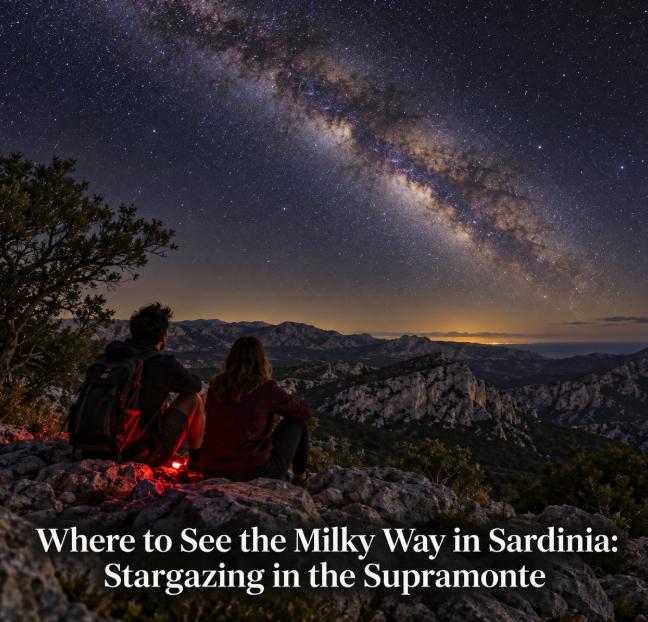
To see the Milky Way in Sardinia, the most important thing is not finding a famous viewpoint but escaping artificial light. The Supramonte is particularly compelling for that purpose: this enormous limestone wilderness spreads across more than 35,000 hectares around Dorgali, Oliena, Orgosolo, Urzulei and Baunei, with plateaus, forests and remote mountain terrain far from the island’s larger urban centers. On a clear, moonless night, the difference between a coastal resort and the dark interior can be dramatic.
The Supramonte has long been highlighted locally for exceptionally dark skies, and nighttime guides currently offer overnight experiences in parts of the massif. But stargazing here requires more planning than pulling off the road and walking into the mountains after sunset. The terrain is rugged, trails can be unclear and phone coverage should never be assumed.
Why the Supramonte works so well for stargazing
The official Sardinia tourism authority describes the Supramonte as a vast mountain complex of plateaus, sinkholes, cliffs, forests, caves and deep canyons covering territories from the Nuoro interior to the Gulf of Orosei. Much of that landscape has very little settlement.
That remoteness is exactly what a stargazer wants. Artificial sky glow decreases as you move away from towns, hotels, roads and illuminated coastlines. A Sardinian meteorology source has specifically identified the Supramonte among the island’s strongest areas for observing the night sky and Milky Way, while current guided nighttime experiences in the Orgosolo Supramonte emphasize the absence of artificial light.
Darkness alone is not enough. Transparency, clouds, humidity, wind and moonlight all affect what you see. A perfectly dark mountain under cloud is useless for astronomy, while a full Moon can wash out much of the contrast in the Milky Way even when the sky is otherwise clear.
Supramonte di Orgosolo: deep darkness and forest
The Supramonte of Orgosolo is a strong choice for travelers who want to combine stargazing with a guided wilderness experience. Current local excursions operate in the Montes forest and describe nights without artificial lights, surrounded by holm oak and juniper woodland.
One guided option goes beyond a brief evening walk and spends the night in the forest. That changes the experience considerably: instead of driving back to a hotel immediately after sunset, visitors can wait for full astronomical darkness and allow their eyes to adapt properly.
It is also a sensible way to experience an unfamiliar mountain environment after dark. A local guide knows the tracks, access points and places where a safe overnight stop is possible.
Oliena and Monte Corrasi
The Oliena side of the Supramonte offers another dramatic setting. Monte Corrasi rises above the town, while the wider landscape around Lanaittu leads into limestone mountains and remote valleys.
A current local operator offers an overnight Supramonte experience beginning from Oliena and traveling by jeep toward the Pradu area at around 1,200 meters before continuing on foot to an overnight base. Depending on group size and weather, the night may be organized with tents or traditional shepherd shelters.
For stargazing, the appeal is obvious: elevation, distance from urban lighting and an open limestone landscape. But Corrasi is mountain terrain, not a casual urban viewpoint. Night access should be treated as an outdoor excursion rather than simply a scenic drive.
Baunei and the Golgo plateau
The Supramonte di Baunei stretches toward the Gulf of Orosei and contains some of Sardinia’s most dramatic limestone scenery. The Golgo plateau is a practical gateway into this landscape and is considerably easier to approach than remote peaks reached only on foot.
Official regional tourism information describes Golgo as the beginning of the Baunei Supramonte, a landscape of karst features, nuragic remains and wild terrain largely untouched by modern development.
For night-sky photography, an open plateau can provide more useful horizons than a narrow forest or canyon. However, photographers should scout any location during daylight first. Trying to compose foreground cliffs, shepherd structures or karst features for the first time in total darkness creates unnecessary risk.
When is the Milky Way easiest to see?
The Milky Way is present in the sky throughout the year, but its bright central region is best positioned for evening viewing from Sardinia during the warmer part of the year. Late spring through summer is particularly popular for Milky Way photography, with the galactic center becoming a prominent target on dark nights.
Timing within the month is just as important as season. Plan around the new Moon or nights when the Moon is absent from the sky during your observing window. A bright Moon can turn an otherwise excellent dark-sky location into a disappointing Milky Way night.
Check the exact moonrise and moonset for your date rather than relying only on the lunar phase. There can be useful dark hours even when the Moon is not exactly new.
Give your eyes time as well. After roughly 20 to 30 minutes away from bright white light, the sky begins to look richer. Avoid repeatedly checking a bright phone screen. A red-light mode or dim red torch is much friendlier to night vision.
Can you see it with the naked eye?
Yes, under sufficiently dark, clear conditions. But the Milky Way does not look like the intensely colored astrophotographs seen online. To the naked eye it appears more like a pale, textured band crossing the sky, with darker dust lanes becoming more apparent as your vision adapts.
A camera can collect light over several seconds and reveal color and structure that human eyes cannot perceive in the same way. That difference is normal and should not be mistaken for poor conditions.
Binoculars can be surprisingly rewarding. They reveal dense star fields and make a simple evening of naked-eye observation much more interesting without requiring a telescope.
Other dark-sky areas in Sardinia
The Supramonte is not the island’s only strong stargazing region. The Gennargentu mountains are also widely associated with very dark interior skies, while the sparsely developed Costa Verde in western Sardinia provides open coastal horizons away from large cities.
Monte Armidda in Ogliastra has an astronomical observatory, making it relevant for travelers who want astronomy rather than simply a beautiful night landscape. In southeastern Sardinia, the Castiadas tourism authority also highlights its dark, clear skies and astronomical observatory.
For a visitor already staying around Dorgali, Cala Gonone, Oliena, Orgosolo or Baunei, however, traveling across the island solely for darker skies may be unnecessary. The Supramonte is already one of Sardinia’s great wilderness environments.
Do not wander into the Supramonte at night unprepared
The darkness that makes the Supramonte attractive for astronomy also removes one of your most important navigation aids. Official regional hiking guidance warns that some Sardinian wilderness trails can have incomplete or unclear marking and recommends guides for demanding routes.
For casual stargazing, choose an accessible location that you have inspected before sunset. Do not attempt a difficult hiking route simply because a light-pollution map shows a darker patch several kilometers from the road.
If you want a genuine night in the interior, book a local guide. Current Supramonte operators offer overnight experiences with guides, bivouac equipment and traditional shepherd shelters, and at least one Oliena-based guide currently advertises services in Italian, English and French.
Tell someone where you are going, carry water and warm layers, and remember that mountain temperatures can feel very different from the beach after dark. A headlamp is essential even if you plan to keep it off while observing.
How to plan a Milky Way night
Start with the Moon. Choose a night close to new Moon or an observing period before moonrise or after moonset. Then check the cloud forecast, humidity and wind on the day itself.
Arrive before sunset. This gives you time to identify safe parking, inspect the terrain and choose a viewing position without navigating unknown limestone in darkness. Stay away from cliff edges, canyon rims and unprotected drops.
Once darkness arrives, minimize white light and wait. You do not need an observatory, telescope or elaborate equipment to appreciate the Supramonte sky. A reclining chair or mat, a warm layer and patience may be enough.
For photographers, a sturdy tripod and a wide, fast lens are more useful than extreme zoom. Compose the foreground before it becomes completely dark and use an astronomy app to understand where the galactic center will appear on your particular date.
The best place to see the Milky Way in Sardinia is ultimately the place where darkness, weather, moon phase and safe access come together. The Supramonte offers an unusually strong combination: enormous undeveloped landscapes, dramatic limestone horizons and real distance from urban lighting. Choose the night carefully, respect the mountain, and the sky can become as memorable as any Sardinian beach.