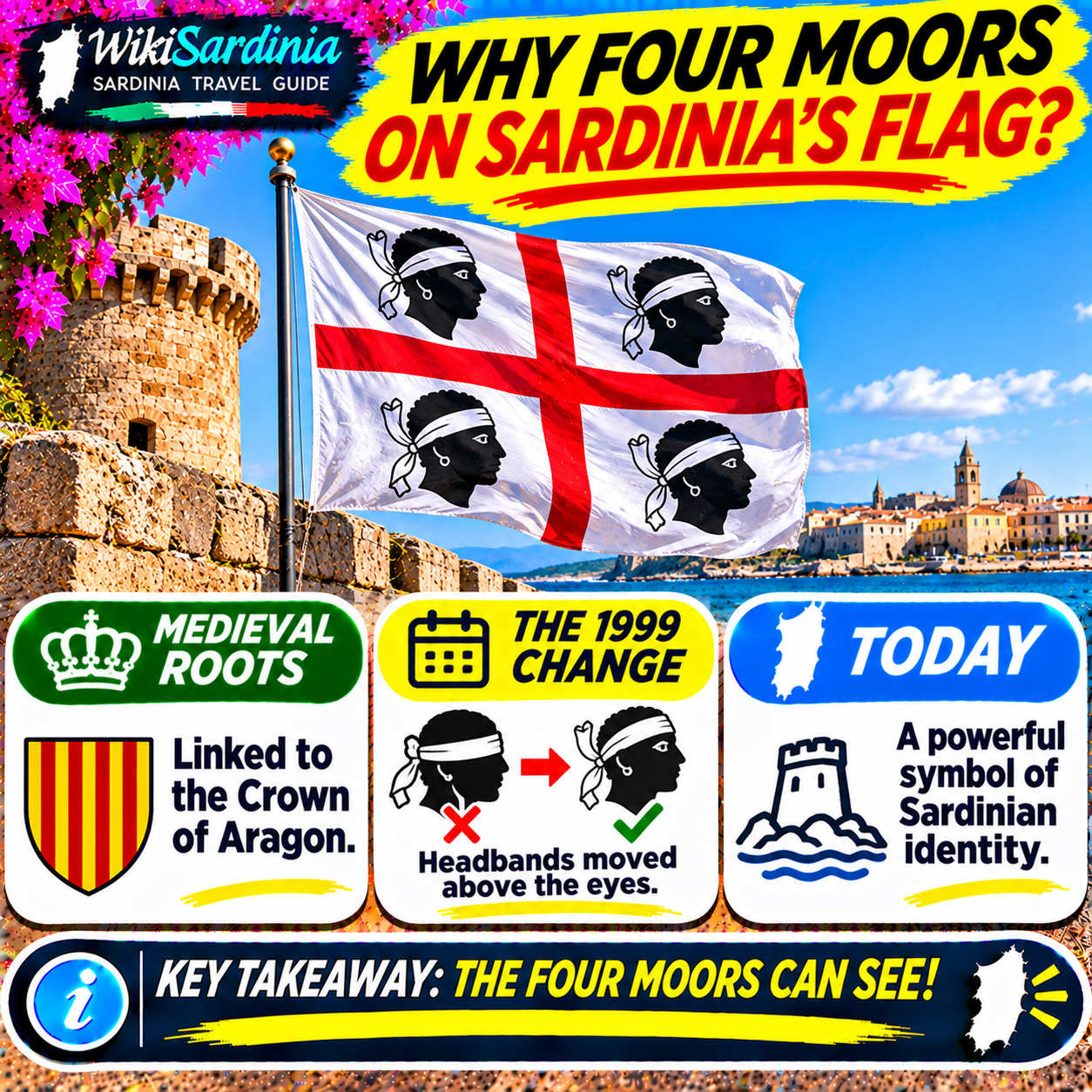
The four heads on Sardinia's flag are called the Four Moors (I Quattro Mori), but on today's official flag they are not blindfolded. The four black profiles wear white bands across their foreheads, leaving their eyes visible. A red cross divides the white background into four quarters. This distinctive emblem has medieval roots in the heraldry of the Crown of Aragon and has become one of the strongest expressions of Sardinian identity. The older, genuinely blindfolded version remains familiar, which explains why visitors often ask why the figures cannot see.
What do the Four Moors represent?
The emblem combines a red cross on white, traditionally associated with Saint George, with four Moorish heads. The word Moor is a historical European label applied to various Muslim populations of North Africa and the Iberian Peninsula; it is not a precise modern ethnic category. The figures belong to medieval heraldry, not a depiction of four identifiable modern Sardinians. Over centuries, the design became associated with the Kingdom of Sardinia and eventually with the island's people, culture and regional institutions.
Why are there four heads?
There is no universally established historical answer to why the original heraldic design included exactly four heads. A well-known legend connects them with four defeated Moorish rulers at the Battle of Alcoraz in 1096, in which Christian forces fought Muslim opponents in northern Spain. Later traditions associated the victory with Saint George. That is a historical legend about the emblem's meaning, not proven evidence that the four profiles portray specific kings. The Regional Government of Sardinia discusses the Alcoraz story while tracing the symbol's documented development through medieval heraldry.
Where did the Sardinian flag originate?
The earliest known evidence for the Four Moors device is associated with a 1281 seal of Peter III of Aragon. The emblem became connected with Sardinia during the fourteenth century, as the Crown of Aragon established its rule over the island. The regional government's institutional history explains that the symbol entered Sardinian heraldry in the mid-1300s and later became closely associated with the Kingdom of Sardinia. Its documentary history is therefore more secure than the popular claim that it originated directly at the Battle of Alcoraz in 1096.
Were the four heads originally blindfolded?
No single version remained unchanged across the centuries. Historical images show the figures with bands on their foreheads, with bands over their eyes, sometimes crowned, and facing in different directions. Sardinia's official regional history explicitly records these variations. The blindfolded depiction became particularly familiar during the Savoyard period and remained prominent in modern usage. The reason for the bands moving over the eyes is debated: explanations range from artistic changes and copying practices to later political interpretations. It should not be presented as a proven deliberate act of humiliation or oppression.
What changed in 1999?
On 15 April 1999, Sardinia adopted Regional Law No. 10 defining its traditional regional flag. Article 1 specifies a white field crossed in red, with a Moorish head in each quarter, the band on the forehead and the faces looking away from the hoist—the edge nearest the flagpole. This restored visible eyes and set an official orientation. The law does not say that the four heads represent four specific Sardinian provinces or four ancient Sardinian kingdoms.
The wording is explicit: “campo bianco crociato di rosso con in ciascun quarto una testa di moro bendata sulla fronte rivolta in direzione opposta all’inferitura.” Source: Italian Government — regional flag legislation, including Sardinia's 1999 law.
Which way should the heads face?
In the official flag, the profiles face away from the flagpole, not toward it. This is more accurate than saying they always face left or always face right, because the side from which a flag is viewed can change its apparent direction. In illustrations where the hoist is at the viewer's left, the heads typically appear to face right. The regional visual-identity guidance confirms the rule about looking away from the hoist. For a historically or legally accurate illustration, check both the forehead bands and the orientation.
Does the blindfold symbolize Sardinians being oppressed?
Some modern interpretations read the old eye-covering bands as a symbol of subjugation and the restored forehead bands as a symbol of renewed dignity or freedom. This interpretation has emotional and political significance for some Sardinians, but it should be distinguished from documentary proof of why earlier artists drew the bands over the eyes. The 1999 redesign is sometimes described as allowing the Four Moors to “see again.” That is a memorable way to explain the modern flag, not an established medieval origin story.
Is the red cross the Cross of Saint George?
Yes. The red cross on a white field is widely identified with Saint George in European heraldic traditions. In stories about the Four Moors, Saint George is linked with the medieval battle narrative, although the story's specific details are not settled history. The cross also helps explain why the flag resembles other medieval Mediterranean and Iberian heraldic symbols. It is not simply a red plus sign added for decoration.
Did the Four Moors come from Sardinia's four medieval kingdoms?
A popular interpretation connects the four heads with Sardinia's four Giudicati, the medieval kingdoms of Cagliari, Arborea, Torres and Gallura. The number four makes this an appealing association, but it is not the established documented origin of the heraldic device. The early evidence points instead to Aragonese royal heraldry. Visitors should treat the Giudicati explanation as a later symbolic reading rather than a verified account of why the design was first created.
When did the Four Moors become Sardinia's official symbol?
The Four Moors were associated with the Kingdom of Sardinia for centuries. In the modern autonomous region, the Regional Council approved the coat of arms in 1950, and a presidential decree of 5 July 1952 formally granted a coat of arms and banner. The separate regional flag was defined by the 1999 law. The regional government's current visual identity continues to use the emblem, with official guidance intended to keep institutional representations consistent. These dates refer to modern legal recognition, not the first appearance of the medieval symbol.
Why do some souvenirs still show blindfolded heads?
Older versions of the emblem remain part of Sardinian visual culture, and not every souvenir or decorative flag follows the official 1999 design. Some use historical images; others repeat an outdated or stylized illustration. A blindfolded version is therefore not proof that the regional law was reversed. If you want the current official flag, look for white forehead bands, visible eyes and heads facing away from the hoist. When buying a flag, check the actual printed design rather than relying on the label alone.
Where will tourists see the Four Moors?
Across Sardinia, the emblem appears on regional buildings, public flags, cultural posters, clothing, stickers, souvenirs and displays of local identity. You may see it in Alghero, Cagliari, Sassari, Olbia and small inland villages. The symbol is also common at festivals and sporting events. It is not merely a tourism logo: for many residents it expresses a strong sense of belonging to Sardinia and its history.
Is it disrespectful for tourists to wear the flag?
Wearing or buying a Sardinian flag souvenir is generally an ordinary way to show appreciation for the island. Respect the emblem's cultural importance, avoid mocking its imagery and be aware that different versions can carry different historical or political associations. If you are curious, asking a local person about the Four Moors can open a thoughtful conversation about Sardinian history and identity.
Does the flag have a controversial history?
The medieval imagery reflects periods of conflict between Christian and Muslim powers around the western Mediterranean, and the term Moor belongs to that historical context. Modern discussions may question the symbolism or interpretations of the heads. It is useful to acknowledge the emblem's origins without treating medieval depictions as neutral portraits of a contemporary community. At the same time, the flag has been reinterpreted over centuries and is now a widely recognized symbol of Sardinian identity.
How can you recognize the correct official flag?
- Look for a white background divided into four quarters by a red cross.
- Each quarter contains one black Moorish head in profile.
- The white band sits across the forehead, not the eyes.
- The heads look away from the hoist, the side attached to the flagpole.
- Remember that historical flags, artwork and souvenirs may deliberately show earlier versions.
Useful Italian phrases
“Perché ci sono quattro mori sulla bandiera?” — Why are there four Moors on the flag? “La benda è sulla fronte, non sugli occhi?” — Is the band on the forehead, not the eyes? “Questa è la bandiera ufficiale?” — Is this the official flag? “Che cosa rappresentano i Quattro Mori?” — What do the Four Moors represent? “È una versione storica?” — Is this a historical version?
Official sources and further reading
Regione Autonoma della Sardegna — History of the coat of arms; Regione Sardegna — Institutional identity and historical variants; Regione Sardegna — Official visual identity and legal references; Italian Government — Regional Law No. 10 of 15 April 1999; Regional Council of Sardinia — Historical and legal discussion of the Four Moors. These distinguish documented heraldic history from legends and later symbolic interpretations.
The WikiSardinia takeaway
The Four Moors are Sardinia's medieval heraldic emblem, now a powerful symbol of island identity. Their exact original meaning is debated, but their connection to Aragonese heraldry and the Kingdom of Sardinia is well documented. Although older flags often show the heads blindfolded, Sardinia's official flag since 1999 places the bands on their foreheads, leaving their eyes visible. Next time you see the red cross and four profiles flying above a Sardinian town, you'll know why the details matter.